
When our church walked through a study on Eschatology, the biblical teaching about last things, one topic kept surfacing with particular intensity: the mark of the beast.
As a group, we did what good Bible students should do. We shared our perspectives openly. We brought our questions to the table. Then we turned together to the relevant passages. There was genuine engagement, honest wrestling, and a real desire to understand what God’s Word says.
Yet when we closed our Bibles at the end of those sessions, we had not reached the same conclusions.
Different interpretations remained. Some were concerned about microchip technology. Others emphasized the symbolic nature of apocalyptic literature. Some were cautious about being too definitive. We finished our study without a unified understanding of what the mark of the beast actually is.
I want to be honest. That unsettled me. Not in a fearful way, but in the way good questions should. The kind that pushes you to keep studying rather than settle for an uncertain answer.
So, I made a commitment to go deeper. I spent more time in the primary texts. I studied the genre, the historical context, and the biblical patterns that Revelation draws from. I listened to careful scholars from different traditions and asked a better question: not what do people say, but what does Scripture say?
I have also encountered many interpretations beyond our Bible study. Some created more fear than clarity. Others raised questions I needed to think through carefully. This article is the result of that ongoing study.
It is written for anyone who feels the same tension. A desire to understand. An awareness that sincere people disagree. And a commitment to let Scripture speak for itself rather than reading our culture into the text.
According to the Bible, the mark of the beast represents allegiance and worship to the beast, not merely a physical object or modern technology.
The mark is tied to worship and allegiance, not to any specific technology.
It is described in symbolic, apocalyptic language consistent with the genre of Revelation.
It is not something taken accidentally. It involves a conscious, willful choice.
Christians are called to faithfulness and discernment, not paralysis and fear.
Why So Many People Fear the Mark of the Beast Today

It would be unhelpful to dismiss why this topic creates anxiety. The fears are real, even when the interpretations behind them are not.
Several factors contribute to this.
Cultural and Online Influence
In the age of social media, sensational prophecy content spreads quickly. A video, post, or podcast can plant an idea deeply. When that idea connects with uncertainty about the future, it takes root fast. For many people, their first exposure to end-times teaching comes from online speculation rather than careful Bible study.
Rapid Technological Change
We now live with biometric data, cashless systems, and digital identification. These developments can feel similar to the economic restrictions described in Revelation 13. What feels possible can easily be assumed to be prophetic.
Misinterpretation of Prophecy
When apocalyptic texts are read too literally, every new development becomes a potential fulfillment. This approach overlooks the nature of the literature.
These concerns are not foolish. They need a careful, biblical response. Not mockery, and not exaggeration.
Understanding the Symbolism in the Book of Revelation
Before defining the mark, we must understand the kind of book Revelation is.
Revelation belongs to apocalyptic literature. This genre was familiar to early Jewish and Christian readers. It communicates spiritual realities through vivid imagery such as beasts, dragons, and symbolic numbers. These images are not meant to be read with strict literalism. They communicate truth through picture language.
We use similar language today. If someone says a person was “thrown under the bus,” no one imagines a literal bus. The phrase communicates betrayal. Apocalyptic language works in a similar way, but with greater depth and intention.
This style is rooted in Scripture. The Old Testament prophets used the same approach. Daniel describes beasts representing kingdoms. Ezekiel uses dramatic imagery to describe God’s glory. Jesus also used apocalyptic language in His teaching about the end.
Revelation follows this pattern. The Lamb is not a literal animal but Christ. The woman in chapter 17 is not a literal person but a system. The same care must be applied to the mark of the beast.
Key point: Revelation communicates spiritual truth through imagery, not technological prediction.
What Does Revelation 13 Say About the Mark?
The key passage is Revelation 13:16–17.
“Also, it causes all, both small and great, both rich and poor, both free and slave, to be marked on the right hand or the forehead, so that no one can buy or sell unless he has the mark, that is, the name of the beast or the number of its name.” — Revelation 13:16–17 (ESV)
Let us observe what the text actually says.
Who gives the mark: The second beast, often called the false prophet, enforces the mark on behalf of the first beast (Revelation 13:11–17). It is part of a system of compulsion and deception designed to draw allegiance away from God.
Who receives it: The mark is received by those who worship the beast (Revelation 13:12). This is the critical detail. The mark does not simply happen to someone; it is connected to an act of allegiance and worship.
The connection to buying and selling: Economic participation is tied to the mark. Those who refuse it are excluded from the marketplace. This creates pressure to conform. That pattern has appeared throughout church history, from Roman emperor worship to totalitarian ideologies.
The number 666: Revelation 13:18 gives the “number of the beast” as 666. In the ancient world, number symbolism was common. Many scholars connect this number to Nero while also recognizing its broader meaning. It represents human rebellion falling short of God’s perfection.
How to Understand the Mark of the Beast Biblically
A simple framework helps bring this passage into focus.
1️⃣ Read in context.
The mark appears in the context of worship. Chapter 13 is inseparable from chapter 14, where the 144,000 are described as having the Father’s name written on their foreheads (Revelation 14:1). This is the contrast Revelation is drawing: the seal of God versus the mark of the beast. Both are about identity and allegiance.
2️⃣ Compare with the rest of Scripture.
The Bible interprets the Bible. The imagery of a mark on the forehead and hand echoes Deuteronomy 6:8, where Israel was commanded to bind God’s commands on their hands and between their eyes.
This was not meant literally; it pointed to internalizing and living out God’s Word in both thought and deed. Revelation is consciously drawing on this same imagery.
3️⃣ Focus on themes, not speculation.
The consistent biblical theme is this: whom do you serve? The mark represents a counterfeit answer to that question.
What Does the Mark of the Beast Represent?
At its core, the mark of the beast represents three interconnected things:
Allegiance to the beast.
To receive the mark is to align oneself with the beast’s authority and power. In the first-century context, this would have resonated with Christians being pressured to offer incense to Caesar and declare Kyrios Kaisar — “Caesar is Lord.” The mark is the symbol of that submission.
Worship and loyalty.
Revelation is explicitly clear that receiving the mark is tied to worshipping the beast (Revelation 13:12; 14:9–11). It is not a passive or accidental act. It is an act of devotion directed away from God.
Identification with a rebellious system.
The beast and his system stand in opposition to God and His kingdom. The mark identifies its bearer as belonging to that system, as opposed to those who bear the name of the Lamb (Revelation 14:1).
This is not merely external.
The forehead and the hand point inward. The mark reflects the orientation of the heart. A person who worships the beast does not stumble into it; they choose it.
The Meaning of the Forehead and the Hand
The placement of the mark is not incidental.
The forehead represents the mind. It reflects beliefs, identity, and loyalty. Being marked on the forehead signifies identification by your beliefs and allegiance.
The hand represents action. It reflects behavior and daily choices. Being marked on the hand signifies your behavior and practical loyalty.
This mirrors the pattern found in Deuteronomy 6:6–8. God’s people were called to love Him with both thought and action. Revelation uses the same image in reverse. The mark of the beast is the counterfeit covenant: a mind and life devoted not to God but to the beast’s system.
Is the Mark of the Beast a Microchip or Technology?
This is the question many people bring to this topic, so it deserves a clear and direct answer.
Technology is not the core meaning of the mark of the beast. That does not mean technology cannot be misused. Every generation has had its own tools of control and coercion. It is wise to think carefully about how modern systems could be used in harmful ways. However, reducing the mark to a microchip or digital ID misreads the text.
Here is why.
The mark is tied to worship. A chip cannot worship. A payment system cannot express allegiance. In the Book of Revelation, the mark functions as a spiritual and covenantal sign. It identifies those who worship the beast, just as the seal identifies those who belong to God (Revelation 7:3).
Could technology be used within a larger system of pressure or control? Possibly. Scripture does not rule out real-world expressions of these patterns. But it does not present technology as the focus. The focus is the heart. The focus is worship.
Strong takeaway: The issue is worship, not machinery.
Can Someone Take the Mark of the Beast Without Knowing?
No.
This is one of the most important clarifications in this discussion, because many sincere Christians carry unnecessary anxiety about accidentally receiving the mark.
Scripture shows that receiving the mark is tied to a conscious act of worship and allegiance (Revelation 13:12; 14:9). It is not something passively acquired. It is not hidden in a routine medical procedure or a payment system.
Consider also what the Book of Revelation says about those who refuse the mark. They do so at great cost, even to the point of death (Revelation 13:15; 20:4). This points to a clear and deliberate choice made under pressure. No one accidentally refuses martyrdom, and no one accidentally accepts the conditions that lead to it.
God calls His people to “patient endurance” and “the faith of the saints” (Revelation 13:10). He does not call them to resist something they could unknowingly fall into.
Christians who love Jesus and seek to follow Him have nothing to fear from accidentally receiving the mark.
Should Christians Be Afraid of the Mark of the Beast?

This brings us to the deepest question. It is not really about technology or prophecy.
It is about the heart. Who has your worship? Who has your ultimate allegiance?
The Book of Revelation was written to suffering Christians under the Roman Empire. They faced pressure to worship the emperor and risked their lives if they refused. The message of the book is not to watch for every possible sign. It is to remain faithful to the Lamb, no matter the cost.
The Apostle John wrote to strengthen endurance, not to stir panic.
Fear of the mark can become a distraction. It pulls attention away from faithful living in the present and redirects it toward constant speculation about the future. This is not the posture Revelation calls for.
Shift from fear to faith. The same God who holds the scroll (Revelation 5) holds your life. The same Lamb who was slain has already overcome (Revelation 5:5). The same Spirit who seals God’s servants (Revelation 7:3) seals you.
Spiritual readiness is the call, not constant monitoring of current events. Are you worshipping Christ today? Are you loyal to Him in your daily choices? Are you holding fast when pressure pushes you toward other allegiances?
That is the question Revelation places before every believer.
Common Misunderstandings About the Mark of the Beast
Misunderstanding #1: The mark is a microchip.
The text does not say this. The mark represents worship and allegiance, rooted in Old Testament covenant imagery. Technology may be used within future systems, but a chip itself is not the mark.
Misunderstanding #2: The mark has already been secretly distributed.
This contradicts the text. The Book of Revelation describes the mark as part of a visible and enforced system tied to economic participation and open worship of the beast. There is no indication of a hidden rollout.
Misunderstanding #3: Vaccines or IDs are the mark.
These claims add ideas that are not in the text. The mark is inseparable from worship of the beast. Medical or governmental processes do not equal spiritual allegiance.
Misunderstanding #4: Christians might receive it accidentally.
As already explained, the mark involves conscious worship and allegiance. It cannot be taken unknowingly.
Misunderstanding #5: The number 666 is a literal code to identify.
The number functions symbolically within its historical and literary context. It points to human rebellion and imperfection, not a barcode or PIN.
Final Thoughts: Focus on Faithfulness, Not Fear

The Bible does not call believers to live in fear of the mark of the beast. It calls them to live in faithful devotion to Christ.
Fear can paralyze, distort, and divide. It fuels suspicion of others, fixation on current events, and, ironically, neglect of our own spiritual condition. Revelation does not end with anxious believers trying to interpret every headline. It ends with the marriage supper of the Lamb, the New Jerusalem, and the promise that God dwells with His people (Revelation 21:3).
This is where history is heading.
Until then, the call is clear: love God, worship Christ alone, hold to His Word, and endure. At its core, the mark of the beast in the Bible confronts every generation with the same question: Will you give your allegiance to the world, or remain loyal to Christ?
Fix your eyes on the Lamb. He is worthy.
Key Takeaway
After studying the relevant passages carefully and prayerfully, here is what Scripture clearly teaches about the mark of the beast:
- The mark is about worship, not technology. Revelation 13 places the mark in the context of worship of the beast. It represents allegiance to a system opposed to God and is foundational to understanding the passage.
- The mark cannot be taken accidentally. It is tied to conscious allegiance and worship. No one receives it unknowingly, and it involves a deliberate decision. This truth brings peace to believers who fear accidental involvement.
- The symbolism is rooted in Scripture. The forehead and hand imagery echoes Deuteronomy 6. The seal of God and the mark of the beast form a deliberate contrast, representing two opposing loyalties rather than technology.
- Faithful Christians may differ on details. Interpretations vary across futurist, preterist, historicist, and idealist views. However, all serious interpretations agree on the core meaning: idolatrous allegiance to a power opposed to God.
- The response is faithfulness, not fear. Revelation was written to strengthen believers, not create anxiety. The central question remains: will you remain loyal to Christ when the cost is high?
Frequently Asked Questions About the Mark of the Beast
What is the mark of the beast according to the Bible?
The mark of the beast is a sign of allegiance to the beast described in Revelation 13. It identifies those who worship the beast and participate in its system. Biblically, it represents loyalty and devotion, not a specific form of technology.
What does the mark of the beast represent?
The mark of the beast represents allegiance, worship, and identification with a system that opposes God. It parallels the seal of God on His people, showing covenantal belonging. In essence, it reflects a heart aligned against Christ.
Is the mark of the beast a microchip?
No, the mark of the beast is not described as a microchip in the Bible. Scripture connects it to worship and allegiance, not technology. Any technological interpretation goes beyond what the text explicitly states.
Can someone take the mark of the beast unknowingly?
No, the mark of the beast cannot be taken unknowingly. It is tied to conscious worship and deliberate allegiance to the beast. Revelation presents it as a clear and intentional choice.
When will the mark of the beast happen?
The Bible does not give a specific time for when the mark of the beast will occur. Revelation emphasizes readiness and faithfulness rather than timelines. The pattern of pressure to abandon Christ has appeared throughout history and will intensify.
What should Christians do about the mark of the beast?
Christians are called to remain faithful to Christ, not fearful of the mark. Revelation emphasizes endurance, obedience, and devotion to Jesus. The focus is on faithful living, not speculation.
This post contains affiliate links, which means I may earn a commission at no extra cost to you if you make a purchase through one of these links. I only recommend products or services I trust and personally use. Thank you for supporting Biblical Christianity!
Recommended Resource
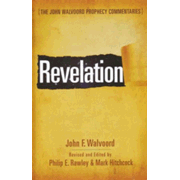
A helpful resource for readers who want a clear, verse-by-verse understanding of the Book of Revelation. This commentary explains the symbolic imagery and major themes of Revelation in a structured way, helping you study the text with clarity and confidence without relying on speculation.
|
Revelation: The John Walvoord Prophecy Commentaries
By John F. Walvoord (Edited by Philip E. Rawley & Mark Hitchcock) A trusted evangelical commentary on the Book of Revelation that walks readers through John’s visions in a clear and structured way. Walvoord explains the seals, trumpets, judgments, and symbolic imagery without sensationalism or speculation. This work is especially helpful for readers who want a serious, verse-by-verse study of Revelation grounded in Scripture. Walvoord defends a premillennial interpretation while still engaging alternative views with care and balance. |