When I first tried to study the Bible regularly, I didn’t struggle with motivation but with direction. I would open my Bible, read a few verses, and then find myself wondering, “What am I supposed to do with this?”
Some days, I would read a whole chapter and still walk away feeling like nothing really stuck. Other days, I felt overwhelmed by all the methods, tools, and advice I kept seeing online. It made Bible study feel more complicated than it needed to be.
Over time, I realized something important: Bible study doesn’t have to start deep; it just needs to start simple.
If you’ve been wanting to study the Bible but feel unsure where to begin, you’re not alone. The good news is you don’t need a complicated system or hours of free time to get started. You just need a clear, simple approach you can follow consistently.
In this guide, I’ll walk you through a step-by-step Bible study routine for beginners; something practical you can start doing today, even if you only have 15 minutes.
• Start simple and stay consistent; depth comes with time.
• Follow the 7-step routine: pray, choose a passage, read slowly, observe, interpret, apply, and respond.
• A 15-minute plan is enough for busy days.
• Focus on understanding and applying Scripture, not just reading.
• Give yourself grace and keep coming back.
Why Starting Simple Matters in Bible Study
Here’s something no one tells beginners: the goal of Bible study isn’t to be impressive. It’s to know God better.
And you don’t need a theology degree for that.
Many beginners fall into the trap of thinking they need to understand everything before they can begin. They look for the perfect method, the perfect Bible, the perfect time of day. But all that planning often becomes a reason not to start at all.

The truth is that consistency matters far more than complexity. Reading one verse and sitting with it for five minutes will do more for your spiritual life than planning an elaborate study you never actually follow through on.
Growth comes from faithfulness, not perfection. God honors the small, steady steps. He meets you where you are, not where you think you should be.
So, give yourself permission to start small. Start messy. Just start.
What You Need to Start Studying the Bible
Let’s keep this list short. You don’t need much.
A Bible
Any readable translation works. If you’re new, consider the New International Version (NIV), the New Living Translation (NLT), or the English Standard Version (ESV). All three are accessible and widely used.
Don’t get stuck agonizing over the “perfect” version. The best Bible is the one you’ll actually read. Pick one and start there.
A Notebook or Journal
Writing things down changes how you process what you’re reading. It slows you down. It helps you notice things you’d otherwise skim past.
You don’t need a fancy journal. A simple lined notebook works just as well. The point is to give your thoughts somewhere to land.
📝 Recommended Bible Study Journal for Beginners
If you’re just starting out, having a simple structure can make a big difference in staying consistent. One beginner-friendly option is The Easiest Bible Study Journal for Beginners: A 100-Day Journey Through the Bible by Susan Mayford and Jason Mayford.
This journal is designed specifically for beginners who want a simple and realistic way to build a daily Bible study habit.
✔ Why it works well for beginners:
- A 100-day plan that feels achievable (not overwhelming like a full-year plan)
- Guided questions to help you understand and reflect on Scripture
- Space to write your thoughts and prayers
- Daily structure that supports consistency and habit-building
- Bonus daily reminders to help you stay on track
Instead of wondering what to do each day, you’ll have a clear path to follow, making it easier to stay consistent and grow in your understanding of God’s Word.
👉 You can check it out here: The Easiest Bible Study Journal for Beginners: A 100-Day Journey Through the Bible
This post contains affiliate links, which means I may earn a commission at no extra cost to you if you make a purchase through one of these links. I only recommend products or services I trust and personally use. Thank you for supporting Biblical Christianity!
Optional Tools (Don’t Overwhelm Yourself)
Once you’ve built a basic habit, you can explore tools like Bible study apps (YouVersion, Logos, and Bible Gateway are popular options), a concordance for looking up words or themes across Scripture, and eventually commentaries for deeper context.
But please, don’t let the tools become the obstacle. Start with your Bible and your notebook. Add tools later when you’re ready.
Now that you have what you need, let’s walk through a simple way to actually study the Bible.
A Simple Step-by-Step Bible Study Routine for Beginners
This is the heart of everything. Seven steps, all doable, all simple.
Step 1: Start with Prayer
Before you read a single word, pause and pray. Ask God to give you understanding. Ask Him to quiet your mind and open your heart.
This doesn’t need to be long or formal. Something as simple as “Lord, help me understand what You’re saying to me today” is enough. The goal is to approach Scripture with humility, remembering this is God’s Word, not just another book.
Step 2: Choose a Passage (Start Small)
Don’t try to read entire chapters or books when you’re just beginning. Pick a short passage, five to ten verses, and stay there.
If you’re not sure where to start, the Gospel of John is one of the best entry points for new believers and curious seekers alike. It’s clear, narrative-driven, and full of Jesus’s own words.
The Psalms is wonderful if you want something emotionally honest and worshipful. Proverbs offers practical wisdom you can apply immediately.
Whatever you choose, resist the urge to jump around. Spend a few weeks in the same book. Context matters, and you’ll understand passages better when you know what comes before and after them.
Step 3: Read the Passage Slowly (More Than Once)
Read the passage through once just to get the overall picture. Don’t stop to analyze anything. Just let it land.
Then read it again. This time, slow down. Notice specific words. Notice what stands out or surprises you. Notice what feels familiar and what feels strange.
Reading slowly is a skill worth developing. We’re used to consuming information quickly. Scripture rewards the opposite.
Step 4: Observe What the Passage Says
Before you can understand what a passage means, you need to see what it actually says.
Ask yourself a few simple questions: Who is speaking in this passage? Who are they speaking to? What is happening? What are the key words or repeated phrases? What stands out to you?
This step is called observation, and it’s the foundation of any good Bible study method. You’re not interpreting yet; you’re just looking carefully.
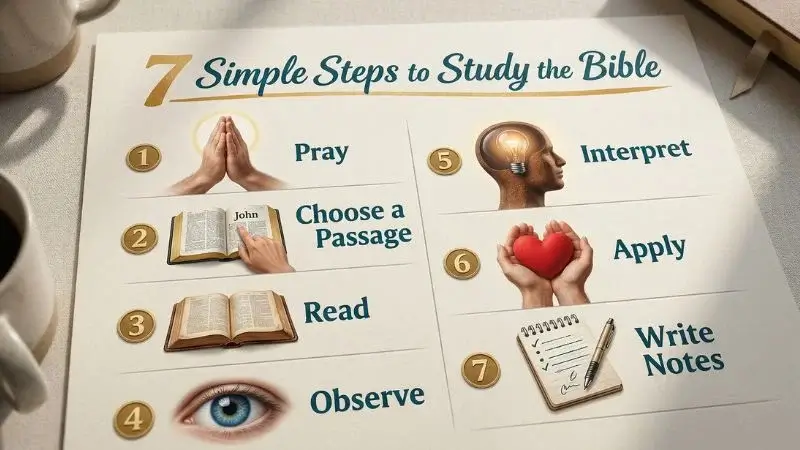
Step 5: Understand the Meaning (Basic Interpretation)
Now you can ask: what does this passage mean?
Two simple questions can guide you here. First, what does this passage teach me about God: His character, His ways, His heart? Second, what does it teach about people: our tendencies, our needs, our relationship with Him?
Keep this step simple for now. You don’t need to dive into deep theological interpretation when you’re starting out. Just ask what the passage is saying and what it reveals.
As you grow in your study, you’ll naturally want to go deeper — exploring historical context, original language meanings, and cross-references. That’s all wonderful. But that’s a later step, not the first one.
Step 6: Apply It to Your Life
This is where real transformation happens. Reading the Bible without application is like reading a recipe and never cooking the meal.
Ask yourself three questions. Is there a command here that I need to obey? Is there a truth I need to believe or trust? Is there a sin or attitude I need to confess and turn from?
Application doesn’t always look dramatic. Sometimes it’s as quiet as deciding to be more patient with your kids because you just read about God’s patience with His people. Sometimes it’s choosing to worry less because you’ve been reminded that God provides.
Small applications, practiced consistently, change a life.
Step 7: Write a Simple Reflection or Prayer
Close your time by writing a few sentences in your journal. It doesn’t have to be polished. It could be a thought, a question you’re sitting with, or a short prayer responding to what you read.
For example: “Lord, this passage reminded me that You are with me even when I can’t see it. Help me trust that today.”
That’s it. One honest response to God’s Word. That’s enough.
A Sample 15-Minute Bible Study Plan (For Busy Days)
Life gets busy. Some days, 15 minutes is all you have. That’s okay. Here’s how to make those 15 minutes count.
1️⃣ 2 minutes
Pray. Ask God for focus and understanding. Take a breath. Slow down.
2️⃣ 5 minutes
Read your chosen passage slowly, twice. Don’t rush.
3️⃣ 5 minutes
Observe and interpret. Jot down two or three things you noticed and one thing you think God is saying through the passage.
4️⃣ 3 minutes
Apply and respond. Write one sentence of application and close in a short prayer.
That’s a complete Bible study right there. You didn’t skip anything important. You opened the Word, you engaged with it, and you responded.
| Time | Activity | Tips |
|---|---|---|
| 2 min | Pray | Ask God for focus and understanding. Take a breath and slow down. |
| 5 min | Read Passage | Read slowly, at least twice. Notice words, phrases, and anything that stands out. |
| 5 min | Observe & Interpret | Write 2–3 observations and one insight about what God is saying to you. |
| 3 min | Apply & Respond | Write one practical application sentence and close with a short prayer. |
For busy moms, especially, this is enough. God doesn’t require an hour of uninterrupted silence. He just needs your willing heart and a few faithful minutes.
If this is all you can do today, do this. It’s enough.
Common Mistakes Beginners Should Avoid in Bible Study
These are gentle reminders, not corrections. We’ve all been here.
Trying to study too much at once.
Reading five chapters in one sitting feels productive, but retention suffers. Depth over breadth will serve you better, especially in the beginning.
Relying only on feelings.
Some days your study will feel rich and meaningful. Other days it will feel dry. That’s normal. The value of God’s Word doesn’t depend on how it makes you feel in the moment. Stay consistent even on the flat days.
Skipping the application step.
It’s easy to observe and interpret, and then close your Bible and move on. But transformation lives in application. Don’t skip it, even when you’re pressed for time.
Getting discouraged by inconsistency.
Missing a day or a week doesn’t mean you’ve failed. It means you’re human. Just come back. Grace is always available, even in your Bible study habits.
Helpful Bible Study Methods You Can Explore Next
Once you’re comfortable with the basic routine, you might want to try a structured method.
The SOAP method is a popular starting point. It stands for Scripture, Observation, Application, and Prayer, which closely follows the steps in this guide. It’s simple and easy to remember.
Inductive Bible study goes a step further, teaching you to observe, interpret, and apply in a more thorough way. It’s a wonderful next step when you’re ready to go deeper.
Verse memorization is another powerful practice. Hiding Scripture in your heart means it’s available to you anytime — in moments of anxiety, decision-making, or temptation.
All of these are tools for the same goal: knowing God through His Word.
Recommended Bible Study Tools (Optional)
Here are a few tools worth exploring when you’re ready:
Bible apps like YouVersion and Bible Gateway give you access to multiple translations, reading plans, and audio versions — all for free. These are great for reading on the go.
A concordance helps you find every place a specific word or topic appears in Scripture. This is especially useful when you want to study a theme across the whole Bible.
Commentaries are written by scholars and pastors who explain the context and meaning of passages in depth. These are helpful once you’ve built a basic foundation. If you jump to commentaries too early, they can become a crutch instead of a supplement.
Use tools to enhance your study. Don’t let them replace it.
How to Stay Consistent in Bible Study
Consistency is the thing everyone wants, and no one finds easy. Here are a few things that actually help.
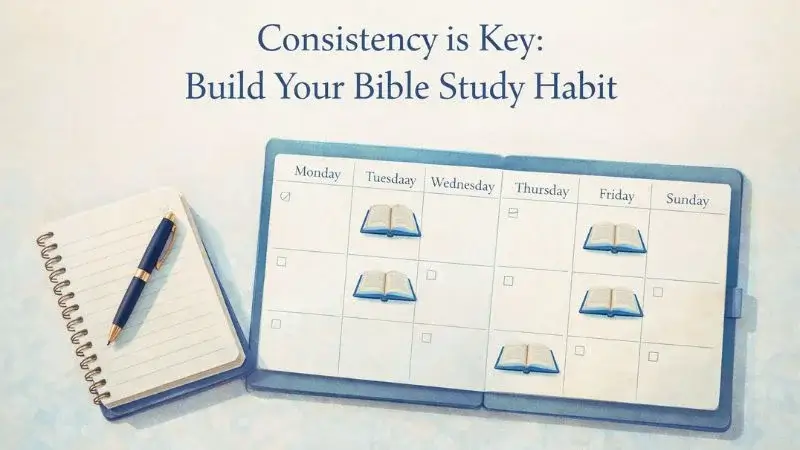
Start small.
A five-minute daily habit is more valuable than a two-hour session once a week. Build the routine first, then expand it.
Set a regular time.
Morning, lunch, naptime, or after the kids are in bed. It doesn’t matter when, as long as it’s predictable. Attach it to something you already do every day.
Give yourself grace.
You will miss days. That’s fine. The goal isn’t a perfect streak. The goal is a growing relationship with God. Come back without shame.
Focus on the relationship, not routine.
Rules are fragile. Relationship is resilient. When you remember that you’re not checking a box but meeting with a Person who loves you, the motivation shifts. That shift changes everything.
Frequently Asked Questions About Bible Study for Beginners
How should a beginner start studying the Bible?
Start with prayer. Choose a short passage from an accessible book like John or the Psalms, and read it slowly more than once. Then ask what the passage says, what it means, and how it applies to your life. Keep it simple. Consistency matters more than using the “perfect” method when you’re just beginning.
How long should Bible study be?
Even 10 to 15 minutes of consistent Bible study can help you grow spiritually. This often leads to more growth than longer sessions done occasionally. As your habit develops, you’ll naturally want to spend more time. Start small and let it grow.
What book of the Bible should I start with?
The Gospel of John is one of the best places to start. It clearly focuses on who Jesus is and is easy to follow. The Psalms are a great choice if you want something more emotional and worshipful, while Proverbs offers practical wisdom for daily life.
Do I need Bible study tools?
No. You only need a Bible and a notebook to get started. Tools like apps, concordances, and commentaries can be helpful later, but they are not essential. Don’t let the lack of tools keep you from beginning.
What is the easiest Bible study method?
The SOAP method (Scripture, Observation, Application, Prayer) is one of the simplest Bible study methods for beginners. It follows a natural flow and keeps your study focused.
The step-by-step routine in this guide follows a similar structure and is designed to help you get started right away.
Final Encouragement: Start Where You Are
You don’t need to understand everything before you begin. You don’t need a theology degree, a perfect morning routine, or the right highlighter color system.
You just need to begin.
God’s Word is alive. It speaks into real life. It meets you in your confusion and your grief and your ordinary Tuesday afternoons. It doesn’t require you to come polished. It just requires that you show up.
So, open your Bible today. Pick a passage. Pray a simple prayer. Write one honest sentence in your notebook.
That’s a Bible study. That’s enough. God will meet you there. He always does.
If this guide helped you, you might also find these helpful: