

You open your Bible, hoping to hear from God.
You read a chapter, maybe two. The words are familiar. You’ve seen them before. But when you reach the end, something feels… distant.
You pause, wondering why it didn’t land the way you expected it to.
So you close your Bible and move on with your day, quietly wishing you understood it more deeply.
Sound familiar? Most of us have been there.
There’s nothing wrong with reading large portions of Scripture. But reading and understanding are not the same thing. God’s Word is meant to be more than something we pass through quickly. It is meant to shape us, guide us, and draw us closer to Him.
And that kind of change rarely happens in a hurry.
Sometimes, the most meaningful growth begins when we slow down and stay with a single verse long enough to truly hear what God is saying. This is one of the most effective ways to learn how to study the Bible effectively without feeling overwhelmed.
That’s exactly what verse-by-verse Bible study invites you to do.
Verse-by-verse Bible study means taking one verse at a time and staying with it long enough to actually understand it. You read it in context, observe the words carefully, ask good questions, compare it with other Scriptures, and then apply what you find. It takes more time than regular reading, but it produces real understanding and real change. Start with one verse, keep a notebook, and pray before you open your Bible.
What Is Verse-by-Verse Bible Study?
Verse-by-verse Bible study is exactly what it sounds like. Instead of racing through chapters, you take one verse at a time and stay with it until you actually understand it.
But it’s more than slow reading. It’s about paying close attention to:
- The individual words and what they mean
- The context surrounding the verse
- The meaning the original author intended
- How that meaning applies to your life today
Think of it as slowing down to truly hear what God is saying. Because most of the time, we skim right past the very thing He wants us to see.
Why Studying the Bible Verse by Verse Matters

It Prevents Misinterpretation
One of the biggest mistakes people make with Scripture is pulling a verse out of its context. When you study verse by verse, you naturally stay connected to the surrounding passage. That alone keeps you from drawing conclusions the text never intended to support.
It Deepens Your Understanding
Surface-level reading gives you information. Verse-by-verse study gives you understanding. When you pause to examine a single verse carefully, you begin to notice things you would have missed in a faster read. Words carry weight, and sentence structure matters. These small details open up big truths.
It Helps You See Context Clearly
Every verse belongs to a bigger story. When you move slowly, you start to see how one verse connects to the verse before it, the paragraph around it, and the book as a whole. Context is not just helpful; it is essential for getting Scripture right.
It Leads to Real-Life Application
You cannot apply what you do not understand. Verse-by-verse study forces you to sit with a text long enough to understand it, which is the only foundation for meaningful application. Rushed reading rarely produces lasting change. Patient study does.
Step-by-Step: How to Study the Bible Verse by Verse
Step 1: Choose a Passage, Not Random Verses
Start with a book or a chapter, not a grab-bag of individual verses. The Psalms are great for devotional study. Philippians, James, or Colossians work well for shorter books. The Gospels are excellent if you want to spend time with the life and teachings of Jesus.
The key is to avoid what some call “verse hopping” — jumping from one random verse to another without any connection between them. Scripture was not written that way, and it should not be read that way either. Choose a starting point and work through it steadily.
Step 2: Read the Verse in Context
Before you zoom in on a single verse, zoom out first. Read the few verses before it and the few verses after it. Ask yourself: Who is speaking here? Who is the original audience? What is the setting? What was just said, and what comes next?
This context is not optional. It is the frame that makes the verse make sense.
Step 3: Observe the Verse Carefully
Now you can slow down and look closely at the verse itself. This is where simple Bible verse analysis techniques begin to make a real difference. Look for:
- Keywords — What words are central to the verse? Are any of them repeated?
- Commands and promises — Is the author telling the reader to do something? Is he making a promise?
- Connecting words — Words like “therefore,” “because,” “so that,” and “but” carry enormous meanings. They show how ideas relate to each other.
If you have done any inductive Bible study before, this observation step will feel familiar. That is intentional. Good Bible study methods overlap, because they are all pointing you toward the same goal: seeing what is actually there in the text.
For a deeper look at observation, check out this step-by-step guide to the Inductive Bible Study Method.
Step 4: Ask the Right Questions
Once you have observed the verse carefully, it is time to dig into its meaning. Good questions to ask include:
- What does this verse actually mean in its original context?
- Why is this verse here? What purpose does it serve?
- What does it teach me about God, His character, His ways, His purposes?
- What does it reveal about humanity, our need, our tendency, our hope?
These questions move you from reading to thinking, and from thinking to understanding.

Step 5: Compare with Other Scriptures
One of the most reliable principles in Bible interpretation is that Scripture interprets Scripture. If a verse is hard to understand, look for other passages that speak to the same idea. A good study Bible will often list cross-references in the margins. Use them.
This is also how you guard against taking one verse and building an entire theology on it. When you read a verse alongside others that address the same truth, you get a more complete and accurate picture.
Step 6: Understand Before You Apply
This step is easy to skip, but it matters. Many of us are so eager to apply Scripture that we jump to application before we have understood the meaning. But an application that is disconnected from meaning is often just self-help dressed in Bible language.
Meaning always comes before application. Ask what the verse meant for its original readers before you ask what it means for you. That sequence matters more than most people realize.
This is also covered more thoroughly in the post on hermeneutics and how to interpret Scripture correctly. It’s worth reading if you want to go deeper.
Step 7: Apply the Verse Personally
Once you understand the meaning, the application becomes much clearer. Ask yourself: What is one specific way this verse should change how I think, speak, or act today?
Keep it practical and specific. Resist the urge to over spiritualize. If a verse speaks to anxiety, ask where anxiety shows up in your actual life. If it speaks to forgiveness, ask who you need to forgive. An application that is general stays in your head. A specific application gets into your heart and hands.
Example of Verse-by-Verse Bible Study
Let’s put this into practice using Philippians 4:6.
The verse:
“Do not be anxious about anything, but in everything by prayer and supplication with thanksgiving let your requests be made known to God.”
Context:
Paul is writing from prison to the church in Philippi. The surrounding verses speak about rejoicing in the Lord and the peace that passes understanding. This is not abstract advice; it comes from a man who is genuinely in difficult circumstances.
Observation:
Notice the contrast; “do not be anxious about anything” is immediately followed by “but in everything by prayer.” The structure is clear: anxiety is the problem, prayer is the response. Also note the word “thanksgiving.” Prayer is not just a petition here. It includes gratitude.
Key questions:
- Why does Paul connect prayer with thanksgiving?
- What does “supplication” add to the idea of prayer?
- What does this verse teach about God: that He is accessible, that He cares, that He hears?
Cross-reference:
Compare with 1 Peter 5:7 — “casting all your anxieties on him, because he cares for you.” Both passages address anxiety and both point to the same solution: bringing your worries to God, trusting that He is attentive and caring.
Application:
Where in my life am I carrying anxiety instead of bringing it to God in prayer? Is there something specific I need to lay down today: a relationship, a decision, a fear about the future?
That is verse-by-verse study in action. One verse. Careful attention. Genuine understanding. Personal application.
Common Mistakes to Avoid
Taking verses out of context.
This is the most common error and the one that causes the most damage. Always read the verse in its surrounding passage before drawing any conclusions.
Rushing through the observation step.
Most people want to get to the “meaning” without actually looking closely at the text first. Slow down. What you observe shapes everything that follows.
Skipping the cross-reference step.
One verse rarely gives you the full picture. Scripture builds on itself, and reading related passages gives you a much richer understanding.
Making the Bible primarily about yourself.
Every passage of Scripture is first about God, who He is and what He has done. Application matters, but it flows from that foundation. When we read the Bible primarily as a self-help guide, we miss its actual point.
How to Study the Bible Daily (Making It a Habit)
Knowing how to study is one thing. Actually doing it consistently is another. Here are a few practical suggestions:
Set a consistent time.
Morning works well for many people, but the best time is the one you will actually keep. Put it in your schedule and treat it like an appointment.
Start small.
One to three verses is enough, especially when you are learning. It is better to study one verse carefully than to skim through an entire chapter. Depth beats volume every time.
Keep a notebook.
Writing down your observations, questions, and applications does something to your understanding that just thinking cannot. It slows you down and forces clarity. A simple journal works perfectly.
Pray before you study.
Ask the Holy Spirit to open your understanding. This is not just a ritual; it is an acknowledgment that you need God’s help to understand God’s Word. Psalm 119:18 is a good prayer to start with: “Open my eyes, that I may behold wondrous things out of your law.”
Tools That Can Help You Study the Bible Effectively
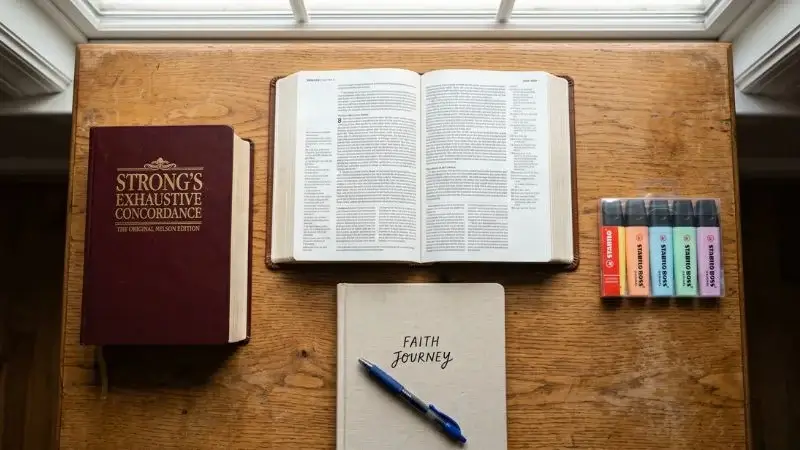
You do not need a library to do good Bible study, but a few solid tools make a real difference.
A Study Bible is a great starting place. It includes notes, cross-references, and background information right on the page. The ESV Study Bible and the NIV Study Bible are both widely trusted options worth having on your shelf.
A Concordance lets you look up every place a particular word appears in Scripture. This is especially helpful when you want to trace a theme or understand how a word is used across the whole Bible. Strong’s Concordance is the classic reference.
A Bible Journal gives you a dedicated place to record your observations, questions, and applications. Some people use a simple composition notebook. Others prefer journals designed specifically for Bible study with structured prompts. Either works; what matters is that you write.
Key Takeaways
- Reading the Bible and understanding it are two different things. Verse-by-verse study bridges that gap.
- Context is everything. Never interpret a verse in isolation from the passage around it.
- Observation comes before interpretation, and interpretation comes before application. The order matters.
- Scripture interprets Scripture. Cross-references are not optional extras; they are part of the process.
- You do not need to study many verses to have a meaningful time in God’s Word. One verse, studied well, is enough.
- The goal is not information. The goal is knowing God more deeply and living differently because of it.
Frequently Asked Questions
What is the difference between reading the Bible and studying it verse by verse?
Reading the Bible gives you a broad overview of a passage. Verse-by-verse study slows you down so you can examine individual words, context, and meaning. The goal is not just to read Scripture, but to understand it and apply it to your life.
Do I need any special tools to study the Bible verse by verse?
No special tools are required. A Bible, a notebook, and a willingness to slow down are enough to get started. A study Bible or concordance can be helpful as you grow, but they are additions, not requirements.
How many verses should I study in one sitting?
One to three verses is a great place to start, especially if this method is new to you. The goal is depth, not volume. It is better to spend twenty minutes on one verse and truly understand it than to rush through a chapter and retain nothing.
What if I do not understand a verse even after studying it carefully?
That is completely normal. Some passages are genuinely difficult. When that happens, look for cross-references that address the same idea, read a trusted commentary, or simply mark the verse and come back to it. Not understanding a verse fully is not a failure; it is an invitation to keep studying.
Can I use this method alongside other Bible study methods?
Absolutely. Verse-by-verse study works well alongside inductive Bible study, topical study, and character studies. In fact, it often strengthens your ability to observe Scripture carefully, which improves every other method you use.
Is verse-by-verse Bible study the same as devotional reading?
No, but they complement each other. Devotional reading is more personal and reflective, focusing on what God is speaking to your heart. Verse-by-verse study is more structured and focused on understanding the meaning and context. Many believers use both—studying carefully first, then reflecting and praying through what they’ve learned.
A Final Word of Encouragement
God did not give us His Word so that we would feel confused or behind. He gave it to us so that we would know Him.
Verse-by-verse study is simply one way of honoring that gift by taking it seriously. You do not have to be a theologian or earn a seminary degree. You just need a willingness to slow down, pay attention, and ask the Holy Spirit to lead you into truth.
Start with one verse today. Stay with it. Let it speak.
You might be surprised at what you find when you stop rushing past the very words God intended for you.
“Your word is a lamp to my feet and a light to my path.” — Psalm 119:105
This post contains affiliate links, which means I may earn a commission at no extra cost to you if you make a purchase through one of these links. I only recommend products or services I trust and personally use. Thank you for supporting Biblical Christianity!
Recommended Resource
If you are looking for a reliable study Bible, the ESV Study Bible is one of the most helpful tools for verse-by-verse study. It includes detailed notes, cross-references, and background explanations that make difficult passages easier to understand.
|
ESV Study Bible, Hardcover
One of the most trusted study Bibles available, the ESV Study Bible is designed to help you understand Scripture clearly and deeply. With extensive notes, cross-references, and articles, it is especially helpful for verse-by-verse study. Whether you are just starting or looking to go deeper, this Bible provides the tools you need to observe carefully, interpret accurately, and apply God’s Word with confidence. |
We truly appreciate this clear and simple guide on how to study the Bible verse by verse. It helps us understand God’s Word in a deeper and more personal way.
Thank you for sharing these practical steps. We believe this will encourage many people to grow in their faith daily.
Thank you so much for your kind words. I truly appreciate it.
I’m grateful to hear that this guide is helping you engage with God’s Word in a deeper and more personal way. That’s really the heart behind it—helping us slow down and truly understand what Scripture is saying.
It’s encouraging to know it may help others grow in their faith as well. That’s something we can all rejoice in.
Blessings to you as you continue studying His Word.