
When I first started this website, I spent a lot of time down rabbit holes. Reading comment sections. Watching YouTube debates. Trying to figure out what I actually believed about some of the bigger theological questions I had quietly carried for years.
One of the first debates I watched was between James White and Michael Brown on the doctrine of election. If you know those two, you know it was anything but boring. White argued from a firmly Calvinist position, Brown from a broadly Arminian one, and both of them came loaded with Scripture, passion, and conviction.
I remember sitting back afterward and just thinking. For a long time.
Because somewhere in the middle of that debate, the question stopped being abstract. It became personal. Did God actually choose me? Or did I choose God? And if it was God who chose, what does that say about the people he didn’t choose? And if it was me who chose, is my salvation somehow resting on the shakiness of my own will?
These are not comfortable questions. But they’re honest ones. And if you’ve ever found yourself asking them, this post is for you.
We’re going to walk through what the doctrine of election actually means, look at both sides fairly, and see what Scripture has to say. No tribal heat, no declaring winners. Just an honest, unhurried conversation, the kind you’d have with a friend over coffee.
The doctrine of election is the biblical teaching that God chooses people for salvation, but Christians have long disagreed on how that choice works. Calvinists believe election is unconditional and rooted entirely in God’s sovereign will, while Arminians believe election is based on God’s foreknowledge of who would freely respond to the gospel. Both views take Scripture seriously and agree on the essentials: salvation is by grace, the gospel invitation is genuine, and believers can have assurance in Christ. While the debate over election continues, Christians can approach it with humility, charity, and confidence in God’s saving work through Jesus Christ.
What Does “Election” Mean in the Bible?
The word “election” in the Bible comes from the Greek word eklegō, which simply means to choose or select. When theologians talk about the doctrine of election, they’re talking about the idea that God, before the world was created, chose certain people to be saved.
Christians across history have never debated whether salvation is by grace alone through Christ alone. The disagreement is about how God’s sovereignty and human responsibility fit together in salvation. That distinction matters because it keeps this conversation grounded in shared Christian truth rather than unnecessary division.

It’s worth noting right away that election isn’t something Paul invented in the New Testament. It runs all the way through the Old Testament. God chose Israel out of all the nations, not because they were the largest or the most impressive, but simply because he loved them (Deuteronomy 7:6-7). The choosing has always been rooted in God’s grace, not in human merit.
So, the question isn’t really whether God chooses. It’s how he chooses, and what that means for human freedom and responsibility.
Calvinism vs Arminianism: What Each View Actually Claims
When people debate election, they’re almost always debating between two major Protestant traditions: Calvinism and Arminianism. Both have serious, Bible-loving theologians behind them. Both take Scripture seriously. They just land in different places on a few key questions.
Here’s a plain-language breakdown of each.
The Calvinist View of Election
Calvinists believe that God’s election is unconditional. That means God did not choose people based on anything he foresaw in them, including their faith. His choice was entirely his own, rooted in his sovereign will and his mercy.
From this view, salvation is completely from God, start to finish. He chooses, he draws, he enables faith, he preserves to the end. Human beings are by nature spiritually dead, incapable of coming to God on their own, so God must first work in a person’s heart before they can respond.
Key Calvinist texts: Ephesians 1:4-5 (“he chose us in him before the foundation of the world”), Romans 9:11-16 (God’s choice of Jacob over Esau “not because of works but because of him who calls”), and John 6:44 (“No one can come to me unless the Father who sent me draws him”).
Famous Calvinists: Augustine, John Calvin, Charles Spurgeon, and John Piper.
The Arminian View of Election
Arminians believe that God’s election is based on his foreknowledge. God, who exists outside of time, looked ahead and saw who would freely respond to the gospel in faith, and he elected those people. His choice is real, but it is not arbitrary. It is a response to the faith he knew people would exercise.
From this view, God genuinely desires all people to be saved (1 Timothy 2:4) and the offer of salvation is sincerely extended to everyone. Human beings have genuine free will, and their response to the gospel matters. Salvation is still entirely by grace; Arminians are not saying people earn their way in. They are saying that grace works through, rather than around, a person’s genuine freedom to respond.
It’s also worth noting that Arminians take seriously the many passages in Scripture that speak of God’s universal love and his desire that none should perish. For them, election is not about God arbitrarily passing over some while choosing others. It is about a God who genuinely pursues everyone and honors the response of those who turn to him in faith.
Key Arminian texts: Romans 8:29 (“those whom he foreknew he also predestined”), 2 Peter 3:9 (“not wishing that any should perish, but that all should reach repentance”), and John 3:16 (“whoever believes in him”).
Famous Arminians: Jacob Arminius, John Wesley, C.S. Lewis, and Roger Olson.
The Key Bible Passages on Election and Why They’re Disputed

Ephesians 1:4-5 says God “chose us in him before the foundation of the world, that we should be holy and blameless before him. In love, he predestined us for adoption to himself as sons through Jesus Christ.”
Calvinists read “chose us” as an individual, unconditional choice made before time. Arminians often read it as a choice of the community “in Christ,” meaning that election belongs to Christ himself, and all who are united to him share in that election.
Romans 9 is the passage that makes most people sweat. Paul talks about God choosing Jacob over Esau before they were born, and about hardening Pharaoh’s heart. Calvinists say this is a clear picture of God’s sovereign, unconditional election of individuals. Arminians say Paul’s point is about God’s freedom to work through unexpected people for his redemptive purposes, and that corporate rather than individual election is still in view.
John 6:37-44 is another key battleground. Jesus says, “All that the Father gives me will come to me,” and “No one can come to me unless the Father who sent me draws him.” Calvinists see this as evidence that God draws only the elect. Arminians point to John 12:32, where Jesus says, “I, when I am lifted up from the earth, will draw all people to myself,” and argue that the drawing is universal, not selective.
Wherever you land, these passages reward slow, honest reading rather than quick proof-texting in either direction.
Where Calvinists and Arminians Genuinely Agree
This is the part that often gets lost in the debate, and it’s actually the most important part.
Both traditions insist that salvation is entirely by grace; no one earns it, no one deserves it, and no one can take credit for it. Both would shout a heartfelt amen to Ephesians 2:8-9. And both believe that God’s love for humanity is genuine, that he is not playing games with people, and that the gospel invitation is sincerely extended to all.
Neither view treats evangelism as pointless or human response as irrelevant. In both traditions, people genuinely believe, genuinely repent, and are genuinely transformed. Neither reduces a person to a passive bystander in their own salvation.
Both traditions also affirm that assurance of salvation is available to the believer. You don’t have to live in anxious uncertainty about where you stand with God. That comfort is not the exclusive property of one camp.
When you zoom out, a Calvinist and an Arminian will preach nearly identical sermons on most Sundays. The disagreements are real, but they are narrower than the culture war around them suggests. What unites these two traditions is far greater than what divides them.
Does Election Mean You Have No Real Choice?
This is probably the question people ask most often when they first encounter the doctrine of election, and it deserves a straight answer.
The short answer is no. But how each tradition gets there is worth understanding.
For Arminians, the answer is straightforward. God’s election is based on his foreknowledge of the choices people freely make. Your faith is genuinely yours. God simply knew, before time began, that you would exercise it. Election doesn’t override your choice; it accounts for it.
For Calvinists, the answer is a little more nuanced but lands in the same place practically. Yes, God is the one who ultimately draws you, enables your faith, and opens your heart. But the faith you exercise is still real faith. The choice you make is still a real choice. God working beneath and through your will doesn’t make your will a puppet; it makes it alive in a way it couldn’t be on its own.
Where the two views differ is not really on whether your choice is real, but on what makes it possible. Arminians say your free will was always intact. Calvinists say God had to first restore what sin had broken before genuine faith was even possible. It’s a meaningful distinction. But both traditions end up in the same place practically: calling you to hear the gospel, trust Christ, and take that response seriously.
Why Election Still Matters for Everyday Faith
You might be thinking: okay, interesting, but why does this matter on a Tuesday morning?
It matters more than you might think.
It shapes how you pray. If God is sovereign in salvation, you can bring your unsaved friends and family before him with real confidence, trusting that he is able to open hearts that seem completely closed. Prayer stops feeling like a long shot and starts feeling like an appeal to someone who actually has the power to act.
It fuels humility. When you understand that your salvation is rooted entirely in God’s grace and not in your own wisdom or goodness, it becomes very hard to look down on anyone. You didn’t figure something out that others missed. You received something you didn’t earn, and that changes how you see people.
It gives assurance. Many Christians quietly wrestle with whether they’ve done enough, believed enough, or held on tightly enough. The doctrine of election, on either reading, redirects your gaze away from yourself and toward God as the one who holds you. That’s a far more stable place to rest.
It drives mission. Counterintuitively, a high view of God’s sovereignty in salvation has historically produced some of the most zealous missionaries the church has ever seen. William Carey, David Livingstone, and Hudson Taylor all worked from a deeply Calvinist conviction that God would call his people from every nation. The Great Commission doesn’t come with an asterisk.
How to Hold This Debate Without Losing Your Mind or Your Friends

If you land on one side of this debate, hold it with conviction but without contempt. This is not a test of fellowship. Christians have disagreed on election for five hundred years and worshipped side by side in the same pews.
A few practical suggestions:
Be slower to speak and quicker to listen when this topic comes up. Most heated arguments about election are really arguments about caricatures, not about what the other side actually believes.
Read the best version of the view you disagree with. Don’t learn Calvinism from an angry Arminian, or Arminianism from a dismissive Calvinist. Read Spurgeon. Read Wesley. Hear them in their own words.
Keep the gospel central. The moment election becomes more central to your conversations than Jesus himself, something has gone wrong.
And extend grace. The people who disagree with you on this are almost certainly worshipping the same Lord, trusting the same Christ, and reading the same Bible with sincere hearts.
The Bottom Line: If You’ve Trusted Christ, You Are Chosen
I started this journey watching two brilliant men debate each other on YouTube, and I walked away unsettled. Not because either of them was wrong to care deeply about what they believed, but because the question had become mine. Personal. Inescapable.
Here is where I landed, and where I want you to land, too.
However the mechanics of election work, and good theologians have debated that for centuries without final resolution, the Bible is clear on this: if you have trusted Jesus Christ as your Lord and Savior, you are among the chosen.
Ephesians 1 says you were chosen before the foundation of the world. Romans 8 says nothing can separate you from the love of God in Christ Jesus.
That is not a reason for pride. It is a reason for worship.
You are not an accident. You are not a maybe. You are not hanging by a thread. In Christ, you are secure, you are loved, and you are held.
The debate between James White and Michael Brown is still going, in one form or another. But you don’t have to wait for it to be settled before you rest in what God has already secured for you.
Let that settle into your bones.
Frequently Asked Questions About Election
What is the doctrine of election in simple terms?
Election is the biblical teaching that God chose certain people for salvation before the world was created. The debate among Christians is whether that choice was unconditional (based purely on God’s will) or conditional (based on God’s foreknowledge of who would believe).
Does election mean I have no real choice?
No, and both traditions agree on that, even if they explain it differently. Head up to the full section above for a careful look at how Calvinism and Arminianism each answer this question.
If God already chose who will be saved, why bother evangelizing?
Because God works through means, and the preaching of the gospel is the primary means he uses. Historically, a strong belief in God’s sovereignty in salvation has produced passionate missionaries, not passive ones. The Great Commission doesn’t come with an asterisk.
Is one view more biblical than the other?
Both views have serious biblical support, which is why the debate has continued for centuries among sincere, Scripture-loving Christians. Rather than declaring a winner here, the better question is: which view do you find most faithful to the full counsel of Scripture, and which view is producing humility, love, and a genuine fear of God in your own life?
Can I be a Christian without having a view on election?
Absolutely. Many healthy, growing Christians hold their view loosely or haven’t fully settled the question. What matters most is not your position on election but your trust in Christ himself.
This post contains affiliate links, which means I may earn a commission at no extra cost to you if you make a purchase through one of these links. I only recommend products or services I trust and personally use. Thank you for supporting Biblical Christianity!
Recommended Resource
|
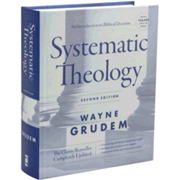
Systematic Theology: An Introduction to Biblical Doctrine, Second Edition
By Wayne Grudem If you want to go deeper into topics like election, predestination, grace, salvation, and the character of God without getting lost in academic language, this is one of the most accessible theology resources available today. Wayne Grudem explains complex doctrines in a clear, readable, and Scripture-centered way, making this an excellent companion for Christians who want to better understand what the Bible teaches and why these conversations matter. |