
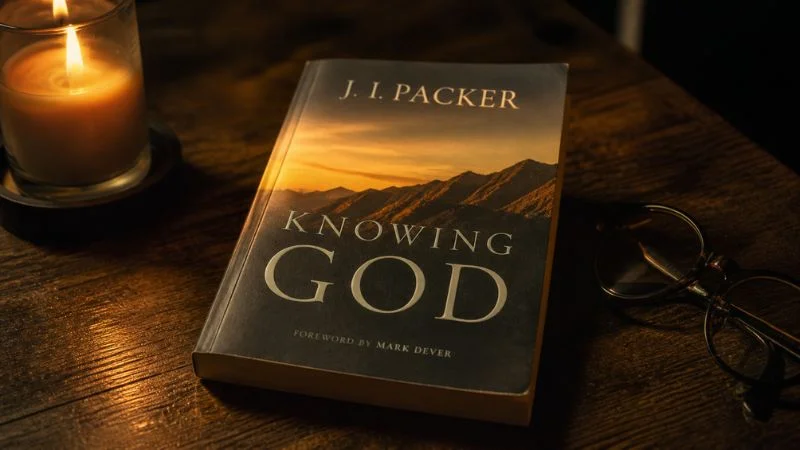
There are books you read. Then there are books that read you.
Knowing God by J.I. Packer is the second kind.
I picked it up expecting a theology textbook. What I found was something far more personal. Page after page, Packer pushed me to ask a question I had quietly avoided for years: Do I actually know God, or do I just know about Him?
That question is the heartbeat of this book. And once it lands, it does not leave you alone.
Who Is This Book For?
Knowing God is not a beginner’s devotional or an academic monograph. It sits between the two, demanding real engagement while remaining genuinely readable.
It is for you if:
- You have been a Christian for years, but sense something is missing in your faith
- You are intellectually convinced of Christian doctrine, but that conviction hasn’t translated into a living relationship with God
- You are new to faith and want a serious foundation, not just surface-level inspiration
- You lead a small group, teach a class, or pastor a church, and want a resource that challenges people to go deeper
- You are an honest skeptic willing to ask hard questions about who God is and whether knowing Him is even possible
Knowing God by J.I. Packer is not just a theology book; it’s a call to move from knowing about God to truly knowing Him personally.
It blends deep doctrine with practical application, exploring God’s character, our relationship with Him, and how true knowledge leads to worship and transformation.
Best read slowly and ideally in a group, this book challenges both new and mature believers to examine their faith, deepen their prayer life, and pursue a real, living relationship with God—not just head knowledge.
Who Is J.I. Packer and Why This Book Still Matters
James Innell Packer (1926–2020) was one of the most influential evangelical theologians of the 20th century. Born in England and later a professor at Regent College in Vancouver, he had a rare gift: explaining deep theology in a way ordinary believers could understand and live.
Knowing God, first published in 1973, grew out of articles he wrote in the 1960s. Those writings resonated deeply, and the book that followed has since reached millions.
What makes it endure is not just its theology, but its purpose. Packer was not writing as a distant academic. He was writing as a believer who had seen the gap between knowing doctrines and knowing God, and wanted to help others cross it.
This is not a book meant to inform you alone. It is meant to confront, guide, and reshape you.
Thematic Exploration: What Is Packer Really Saying?

The Central Thesis
Packer opens with a claim that sets the tone for everything that follows. Knowing God is the most important thing a human being can do. Not knowing about God. Knowing God.
The distinction is not semantic. It is the entire point.
Knowing about God means passing a theology exam. Knowing God means living inside a relationship with the Creator of the universe. Packer argues that much of modern Christianity has settled for the former and called it sufficient. He refuses to let his readers do the same.
Understanding God
The book’s first major movement is theological. Packer walks through the attributes of God: His majesty, wisdom, holiness, love, grace, and wrath. But he does not present these as abstract categories. Each attribute is treated as a facet of a Person you are personally invited to encounter.
He anchors everything in Scripture. Jeremiah 9:23-24 functions as a kind of compass for the whole book: boast not in wisdom or strength, but in knowing the Lord.
The chapters on God’s sovereignty and God’s grace are among the most powerful. On sovereignty, Packer is unflinching. God’s absolute control over all things is not presented as a philosophical puzzle but as a source of genuine comfort for anyone trying to navigate an uncertain world.
On grace, he argues that it is not God simply being lenient. It is God acting with lavish, undeserved, irreversible kindness toward people who have no claim on it whatsoever. Understanding that at depth, Packer says, changes a person.
Relationship With God
The book’s second major movement is relational. Packer argues that true Christianity is not a system of rules but a living relationship, and he uses the concept of divine adoption to make the point with unusual force.
The chapter on God as Father is one of the most affecting in the book. When you truly grasp that you are not a servant under contract but a child under grace, it reshapes how you pray, how you endure suffering, and how you treat others.
Packer takes a doctrinal concept and shows you exactly why it matters at 2 a.m. when nothing feels solid.
Worship of God
The third theme is doxological. Genuine knowledge of God always leads to worship. Packer is concerned that Christianity can collapse into a self-improvement project. When we truly see who God is, the only fitting response is awe, gratitude, and praise.
He does not let worship stay inside the church building. He connects it to obedience, ethics, and the way we treat people on an ordinary Tuesday. Worship that ends at the church door on Sunday is not what Packer is describing.
The section on guidance also deserves mention here. Packer pushes back against simplistic formulas for “finding God’s will” and offers a richer alternative: Scripture, wisdom, counsel, and prayer working together. It is one of the most practically useful sections of the book.
How to Facilitate a Group Study on ‘Knowing God’
Why This Book Works in a Group
Some chapters in Knowing God are dense. Some will challenge assumptions readers didn’t know they held. That is precisely why group study suits it well.
Reading alongside others forces you to articulate what you believe. Other people’s questions surface things you glossed over. The theological struggles you assumed were uniquely yours turn out to be widely shared. A group of six to twelve people tends to work best: large enough for varied perspectives, small enough for honest conversation.
A Suggested Study Plan
The book has twenty-three chapters across four sections. Ten to twelve weeks gives the material room to breathe.
Weeks 1-2: Chapters 1-4. What does it mean to know God? What is lost when Christians settle for knowing only about Him?
Weeks 3-5: Chapters 5-10. The character and attributes of God. Cover one or two attributes per session rather than rushing.
Weeks 6-8: Chapters 11-16. God in relationship with His people. Adoption, guidance, and suffering fit naturally together here.
Weeks 9-10: Chapters 17-23. The shape of the Christian life in light of knowing God.
Weeks 11-12: Review, personal reflection, and application. What has shifted? What still needs to?
Discussion Questions Worth Using
Mix two types of questions each session. Comprehension questions confirm the group understood Packer’s argument. Reflection questions push toward personal honesty.
Some worth returning to across the study:
- Packer distinguishes between knowing about God and knowing God. Where do you see that gap in your own life?
- Which attribute of God is hardest for you to genuinely believe? Why?
- How has your understanding of God as Father shaped the way you pray?
- Packer calls God’s sovereignty a source of comfort. Do you find it comforting? What would need to change in your thinking for you to?
- What does Packer’s vision of guidance look like applied to a real decision you are facing right now?
Recommended Resources
To get the most out of your study, these companions are worth having alongside the book:
Study Aid
- Knowing God Study Guide by J.I. Packer — written specifically for group use, following each chapter with discussion and reflection questions
Bible Reference
- ESV Study Bible — helpful for following Packer’s Scripture references in their wider context
Supplemental Listening
- Tim Keller’s sermons on the character of God — accessible, free online
- R.C. Sproul’s teaching on God’s holiness — pairs naturally with Packer’s attribute chapters
Further Reading
- The Knowledge of the Holy by A.W. Tozer — covers similar terrain with a devotional intensity that complements Packer’s more structured approach
Applying Knowing God in Daily Life

The Gap Between Reading and Changing
Packer is explicit: he does not want informed readers. He wants transformed ones. Reading a theology book and letting it actually change you are two different things, and he knows it.
The most immediate place this shows up is in prayer. When you genuinely believe God is sovereign, holy, and personally invested in you, it changes how you approach Him. Prayer shifts from a transaction to a conversation.
Many readers report that after engaging seriously with this book, they stopped treating prayer as a last resort and started treating it as a first response.
What Readers Say
The book’s impact shows up in testimonies across decades and across very different kinds of readers.
Some describe it as the book that held their faith together during a period of serious doubt. Packer does not flinch from hard questions, and that honesty matters to people who have felt they must hide their uncertainty.
Others describe it as a corrective. They came to faith in environments that emphasized emotion and experience, and Knowing God gave them a theological foundation they hadn’t known they were missing.
Pastors frequently cite it as one of the books that most shaped their ministry. The emphasis on knowing God personally rather than professionally is something ministers return to throughout their careers.
Practices That Follow Naturally
Readers who take the book seriously tend to develop similar habits over time.
Daily Scripture meditation. Not reading for information, but sitting with a passage long enough to let it speak. Packer models this posture throughout the book.
Attribute-focused prayer. Beginning prayer not with a list of requests but with reflection on who God is. Packer’s attribute chapters become a practical map for this.
Community. Packer is clear that knowing God is not a solo undertaking. It happens in the church, in relationship with others who are being shaped by the same truth.
Journaling. Writing out responses to each chapter forces clarity and slows the reading down in a productive way.
The Question That Stays
The most searching question the book leaves behind is simple: Has knowing more about God actually changed you?
Packer has no interest in theological knowledge as a trophy. He is after people who are genuinely, measurably different because they have encountered the living God. That standard is uncomfortable. It cuts through spiritual performance and asks what is actually true, not just what you profess.
Key Takeaways

- Knowing God is not a theology textbook. It is a pastoral call to genuine, personal relationship with God.
- The three core themes of understanding, relationship, and worship are interwoven, not sequential. Each one deepens the others.
- Group study is one of the most effective ways to engage with the book. Structured questions push past comprehension into honest reflection.
- The most immediate practical application is prayer. Readers who absorb Packer’s vision of God tend to pray with more confidence and persistence.
- The questions this book raises are not dated. They are the most important questions any person can ask, in any decade.
Frequently Asked Questions
Is it suitable for new Christians?
Yes, with some guidance. Packer writes clearly, but some chapters assume basic theological familiarity. New believers do best reading it with a mentor or within a structured group.
How long does it take to read?
Around eight to ten hours at an average pace. One or two chapters at a time, with space for reflection between sessions, is the approach most readers find valuable.
Which edition should I buy?
The standard InterVarsity Press edition is widely available. The 20th Anniversary Edition adds a helpful foreword. Either works well for personal or group use.
Is there a companion study guide?
Yes. Packer and Carolyn Nystrom co-authored one designed for groups, following each chapter with discussion and reflection questions.
How does it compare to other theology books?
It sits in its own category: more accessible than Grudem or Berkhof, more theologically serious than most devotionals. Tozer’s The Knowledge of the Holy and Sproul’s The Holiness of God are the titles most often mentioned alongside it.
Can it serve as the basis for a sermon series?
Many pastors have done exactly this. The book’s structure maps naturally onto a multi-week series on the character of God and the Christian life.
Conclusion: The Book That Keeps Coming Back to Find You
Here is what is unusual about Knowing God: it does not stay where you left it.
You read it in your twenties, and it gives you a foundation. You return to it in your forties, and it meets questions you didn’t have the first time. You pick it up in a season of loss and find that Packer already understood what you would need.
That staying power is not accidental. It belongs to books built on something true enough and large enough to keep growing in.
Packer spent his life asking whether people truly knew God. Not whether they attended the right church or used the right words. Whether they knew Him.
That question does not age. It finds us wherever we are.
If you haven’t read Knowing God, don’t wait for the right moment. Start tonight. Read it slowly. Let the questions it raises actually settle in.
And if you have already read it, maybe it’s time to go back. Some books deserve more than one visit.
This isn’t a book to rush, but it is one worth starting. If you don’t have a copy yet, you can get Knowing God here and begin reading at your own pace.
This post contains affiliate links, which means I may earn a commission at no extra cost to you if you make a purchase through one of these links. I only recommend products or services I trust and personally use. Thank you for supporting Biblical Christianity!