

I was not raised in a Christian home, but I always considered myself one. Growing up, I attended Mass regularly and was deeply involved in Catholic traditions. I believed that being religious and trying to be a good person was enough to make me right with God.
When I was around 10 or 11 years old, I attended a Vacation Bible School where I heard the gospel in a way that finally made sense to me. I prayed to receive Christ, but my understanding was still shallow, and over time I drifted back into a more nominal faith.
Years later, through a series of personal trials and a friend’s invitation to church, God truly began changing my life. I recommitted my life to Christ, was baptized, and eventually began serving in ministry. You can read more of my story on my About Me page.
I share that background because it is why I take this question seriously. My goal is not to attack Catholics, many of whom sincerely love God and desire to follow Jesus. But eternity matters too much for vague or comfortable answers. I know what it is like to be religious while still misunderstanding the gospel.
The question is not whether Catholics are sincere. The question is whether Catholic teaching and the biblical gospel are the same thing.
While Catholics and evangelical Christians share foundational beliefs about Jesus, they differ significantly on the gospel itself. Catholic teaching holds that salvation involves faith, the sacraments, and cooperation with grace. The biblical gospel teaches that salvation is a free gift received through faith in Christ alone.
Why the Gospel Matters So Much
The gospel is not just one Christian doctrine among many. It is the foundation on which everything else stands. Paul wrote in Romans 1:16 that the gospel “is the power of God for salvation to everyone who believes.” It is the message that determines where a person spends eternity.
That is why Paul was so sharp in his warning to the Galatians: “If anyone is preaching to you a gospel contrary to the one you received, let him be accursed” (Galatians 1:8-9). He said it twice, in back-to-back verses, as if to make sure no one missed it. Paul was not willing to soften the issue for the sake of keeping the peace. Distortions of the gospel, even small ones, are treated in Scripture as a serious matter.
The gospel is not about being religious or moral. It is the message of how sinners are reconciled to a holy God.
What Is the Biblical Gospel?
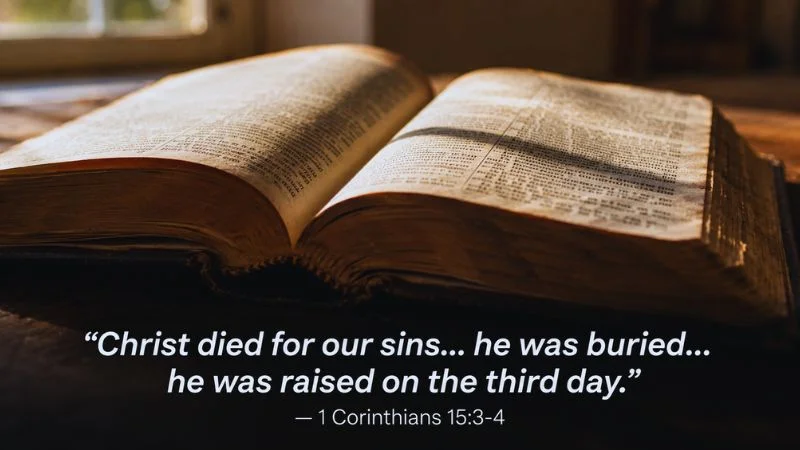
Paul gives us the clearest summary of the gospel in 1 Corinthians 15:1-4. He says the gospel is this: “that Christ died for our sins in accordance with the Scriptures, that he was buried, that he was raised on the third day in accordance with the Scriptures.”
Christ died in our place. He was buried, confirming his death was real. He rose again, confirming his victory over sin and death was real. This is the message.
And how does a person receive the benefit of that work? Paul is equally clear. “For by grace you have been saved through faith. And this is not your own doing; it is the gift of God, not a result of works, so that no one may boast” (Ephesians 2:8-9).
Salvation is by grace alone, through faith alone, in Christ alone. Romans 3:28 puts it plainly: “a person is justified by faith apart from works of the law.” Titus 3:5 adds that God “saved us, not because of works done by us in righteousness, but according to his own mercy.”
The consistent witness of the New Testament is that salvation is entirely God’s work, received through faith, not achieved through human effort or religious participation.
What Catholics and Evangelical Christians Actually Agree On
Before going further, it is worth acknowledging that there is genuine common ground between Catholics and evangelical Protestants, and ignoring that would be dishonest.
Both affirm the Trinity. Both affirm the full deity of Christ. Both affirm that Jesus physically died and physically rose from the dead. Both affirm the reality of sin and the reality of final judgment. Both hold the Bible in high regard, even though they disagree on its relationship to church tradition. These are not small things. On many of the foundational facts of Christianity, Catholics and evangelicals stand together.
But here is the thing: agreeing on doctrines about Christ is not the same thing as agreeing on how a person is saved. A person can affirm the right facts about Jesus while trusting in the wrong things for their standing before God.
The Main Difference: Grace Alone vs. Grace Plus Sacraments
This is where the real difference between the Catholic and evangelical understanding of the gospel becomes clear.
The Protestant Reformation was not primarily about church politics or personal rebellion against Rome. At its heart, it was a debate about this very question. Martin Luther, studying Romans and Galatians, became convinced that the Bible teaches justification by faith apart from works, and that the church had obscured the simplicity of the gospel by adding sacramental systems to the process of justification.
Whether one agrees with the Reformers or not, the central issue was ultimately this: What must a person trust in to be saved?
That question is still the right one to ask.
The Evangelical View
Evangelical Christians hold that salvation is received entirely by faith in Christ. God declares a sinner righteous based on Christ’s righteousness, received through faith. Good works flow from salvation as its fruit and evidence. They are not a contributing cause.
Paul makes this point in Ephesians 2:10, right after his statement about grace through faith: “we are his workmanship, created in Christ Jesus for good works.” The works follow; they do not precede or produce justification.
Romans 4:4-5 puts the logic starkly: “Now to the one who works, his wages are not counted as a gift but as his due. And to the one who does not work but believes in him who justifies the ungodly, his faith is counted as righteousness.”
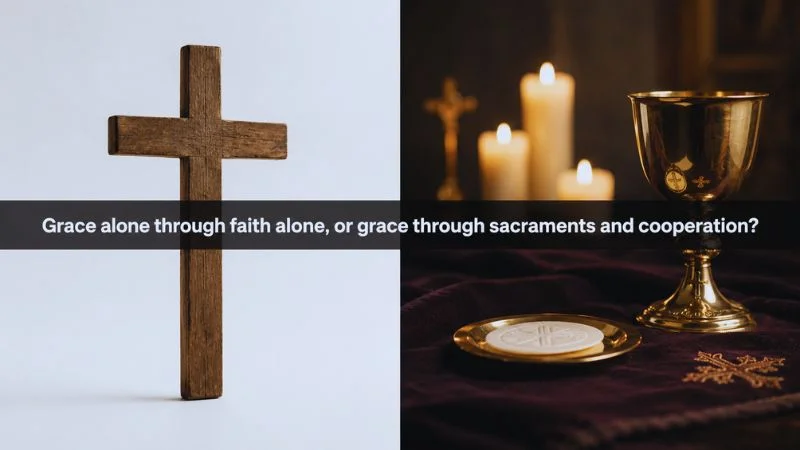
The Roman Catholic View
According to official Roman Catholic teaching, grace is genuinely necessary for salvation. Catholicism does not teach that people earn their way to heaven through sheer willpower.
But Catholic theology also teaches that grace is ordinarily transmitted through the sacraments. Baptism is said to wash away original sin and initiate a person into the state of grace. Confession restores grace after mortal sin. The Eucharist nourishes and increases grace.
A Catholic who dies in a state of mortal sin without absolution faces damnation or purgatory. Final salvation, in this framework, depends not only on Christ’s atoning work but also on a person’s cooperation with grace through sacramental participation and a life of ongoing faithfulness.
The issue is not whether Christians should obey God. Of course they should. The issue is whether sacraments and cooperation with grace contribute to a person’s justification before God. The Bible presents justification as a gift received entirely through faith in Christ, while Catholic theology includes sacramental participation and cooperation with grace as part of the process. That is a real and significant disagreement.
Does the Bible Teach Salvation by Faith Alone?
Romans 5:1 says, “Therefore, since we have been justified by faith, we have peace with God through our Lord Jesus Christ.” The justification comes first, then the peace. It is not an ongoing process maintained through sacraments. It is a declared status based on faith in Christ.
Galatians 2:16 says, “we know that a person is not justified by works of the law but through faith in Jesus Christ, so we also have believed in Christ Jesus, in order to be justified by faith in Christ and not by works of the law, because by works of the law no one will be justified.”
What Is the Difference Between Justification and Sanctification?
Part of the confusion in these discussions comes from failing to distinguish justification from sanctification.
Justification is God’s declaration that a sinner is righteous because of Christ. It happens through faith apart from works. Sanctification is the lifelong process of growing in holiness and obedience after salvation.
The Bible teaches that good works are the fruit of salvation, not the root of it. Christians obey God not to earn justification, but because they have already been reconciled to him through Christ.
If you want a deeper explanation of how justification, sanctification, and glorification fit together, see The Three Phases of Salvation.
What About James 2?
Someone always raises James 2, which says, “faith without works is dead.” This is a fair passage to bring up. But James is not teaching that works contribute to justification before God. He is teaching that genuine faith produces works. A faith that produces absolutely nothing in a person’s life is not saving faith; it is intellectual agreement, which is different.
James is talking about the evidence of faith, not the grounds of it. Works demonstrate that faith is real, but they neither earn favor with God nor add to what Christ has already accomplished. For a fuller treatment of how James and Paul fit together, see James and Paul on Faith and Works.
Assurance of Salvation: Can We Know We Are Saved?
This question is close to my heart. One of the most meaningful things about the gospel of grace is that it gives genuine assurance.
The apostle John wrote his first letter for a specific reason: “I write these things to you who believe in the name of the Son of God, that you may know that you have eternal life” (1 John 5:13). Not hope; you have eternal life. Not feel pretty good about your chances. Know.
Jesus himself said in John 5:24, “Whoever hears my word and believes him who sent me has eternal life. He does not come into judgment, but has passed from death to life.”
That assurance is grounded in Christ’s finished work, not in a person’s ongoing religious performance. Because Christ’s work is complete, the believer’s standing is secure.
In traditional Catholic theology, final salvation remains uncertain during this life. A person can lose grace through mortal sin and must maintain their standing through confession, penance, and the sacraments. For many Catholics, genuine assurance of salvation is seen as presumptuous. The result is that many sincere Catholic believers live without the settled peace that Scripture says believers can have.
True assurance does not come from confidence in our own perfection. It comes from trusting in the One who is perfect. If you want to go deeper on this, I have written more about it in Assurance of Salvation.
Can a Catholic Be Truly Saved?
This question deserves a careful answer.
Salvation is by grace through faith in Christ, not by membership in any denomination. God is not checking church directories. He is looking at the heart and at the object of a person’s trust.
Some Catholics, despite official church teaching, genuinely place their full trust in Christ alone for their salvation. They may have encountered Christ personally through Scripture, through a moment of genuine conversion, or through the grace of God working around the edges of their tradition. God is not limited by institutional structures. If a person is truly trusting in Christ and not in sacraments or religious performance for their standing before God, there is every reason to believe they are genuinely saved.
But many Catholics, if asked what they are trusting in for salvation, would describe a combination of their baptism, their reception of the sacraments, their confession of sins, and their general effort to live a good life. That is not the gospel. That is a confidence placed partly in Christ and partly in religious effort. And Scripture does not teach that kind of divided trust as the path to salvation.
The question that matters more than denominational identity, family tradition, or religious background is this: Is your confidence fully in Christ and his finished work, or partly in yourself?
Why Getting the Gospel Right Matters
Jesus’ words in Matthew 7:21-23 are sobering. He describes people who called him Lord, prophesied in his name, and did mighty works, yet he says to them, “I never knew you; depart from me.” Religious activity, even impressive religious activity, is not the same as a relationship with Christ through faith.
Paul’s warning in Galatians 1:8 stands regardless of how uncomfortable it makes us. A gospel that adds human effort or sacramental participation to faith in Christ is a different gospel. That matters because people’s eternities are at stake.
The Gospel Matters More Than Religious Identity

If you grew up Catholic, I am not writing this to dismiss your experience or suggest that nothing in your background was meaningful. I grew up in that tradition, too. I understand the sincerity and devotion that many Catholic believers bring to their faith.
My own mother is a devout Roman Catholic. I love her deeply, and nothing about this conversation changes the way I look at her or treat her. But love is precisely why these questions matter. Telling someone their religious life is fine when Scripture says otherwise is not kindness. It is the opposite.
Sincerity is not the same as the gospel. The question that ultimately matters is not whether we are religious, devout, Catholic, or Protestant. The question is whether we are trusting completely in Jesus Christ and his finished work to save us, or whether we are placing some of that confidence in our own participation, effort, or performance.
The biblical answer is clear. Salvation is a free gift, received by faith, resting entirely on what Christ has done. That is the gospel. And it is worth getting right.
If you are unsure where your confidence truly rests, open the Scriptures and read through Romans, Galatians, and the Gospel of John slowly and prayerfully. Ask God to show you the truth about salvation and the sufficiency of Christ. Do not settle for inherited religion or vague spirituality.
Eternal life is found in Jesus Christ alone, and his invitation is open to all who come to him by faith.
Frequently Asked Questions
Do Catholics believe in Jesus?
Yes. Catholics affirm the full deity of Christ, his physical death, and his bodily resurrection. There is genuine agreement on the facts about Jesus.
Do Catholics believe salvation is by grace?
Yes, but Catholic theology also teaches that grace is transmitted through the sacraments and that a person must cooperate with grace through ongoing participation in church life and avoidance of mortal sin.
What is the difference between the Catholic gospel and the biblical gospel?
The central difference is over justification. The biblical gospel teaches that justification is received by faith alone in Christ. Catholic teaching holds that justification involves sacramental participation and ongoing cooperation with grace.
Can good works save a person?
No. The Bible consistently teaches that good works cannot save anyone. Works are the fruit and evidence of genuine saving faith, but they are not its cause or ground.
Can Christians have assurance of salvation?
Yes. Scripture teaches that believers can know they have eternal life, not based on their own performance, but based on Christ’s finished work and God’s promises.
Are Catholics Christians?
Catholics identify themselves as Christians and affirm the Trinity, the deity of Christ, his death and resurrection, and the authority of Scripture. In that sense, Catholicism is historically connected to the Christian faith.
But the deeper question is whether a person trusts the biblical gospel. Scripture teaches that salvation comes by grace through faith in Christ alone, which is why the question of the gospel matters so much in this discussion.
What does the Catholic Church teach about salvation?
The Roman Catholic Church teaches that salvation begins with grace and is connected to the sacraments, starting with baptism. Catholic theology also holds that believers must cooperate with grace through faithfulness, participation in the sacraments, confession, and perseverance.
Evangelical Christians, by contrast, believe that justification is a free gift received entirely through faith in Christ apart from works, with good works understood as the fruit of salvation rather than a contribution to it.
What is the difference between grace and works?
Grace is God’s undeserved favor toward sinners. The Bible teaches that salvation is a gift of grace, not something people earn through moral effort or religious activity. Works are the acts of obedience that flow from genuine faith.
Christians are called to live holy lives, but those works do not save them. According to Scripture, works are the evidence of salvation, not the cause of it. Salvation rests entirely on the finished work of Christ.
This post contains affiliate links, which means I may earn a commission at no extra cost to you if you make a purchase through one of these links. I only recommend products or services I trust and personally use. Thank you for supporting Biblical Christianity!
Recommended Resource
If you want a deeper biblical look at salvation, grace, and genuine saving faith, The Gospel According to Jesus by John MacArthur is a helpful and gospel-centered resource. It clearly explains what Scripture teaches about faith, repentance, assurance, and the finished work of Christ.
|
The Gospel According to Jesus: Revised & Updated Anniversary Edition
By John MacArthur What does it truly mean to trust in Christ for salvation? In this influential and gospel-centered book, John MacArthur explores Jesus’ call to discipleship and explains the difference between genuine saving faith and empty religious profession. Rooted in Scripture, this resource helps readers understand grace, repentance, faith, and the finished work of Christ. It is especially helpful for those wrestling with questions about salvation, assurance, and the true gospel. |
This was an interesting read. I grew up hearing different opinions about Catholics and Christians, so I appreciate how you explained the topic without making it feel judgmental. It helped me think more about what the gospel really means and why understanding the Bible clearly is so important.
What would you say is the main point people should understand first when comparing these beliefs?
Thank you, Monica. I really appreciate your kind words.
I’m glad the post helped you think more deeply about the gospel without feeling like it was attacking anyone’s background.
To me, the main point people should understand first is this: both Catholics and evangelicals affirm many of the same truths about Jesus, but the real difference lies in how salvation is received.
The Bible presents salvation as a free gift received by faith in Christ alone, while Catholic teaching often connects salvation with sacraments and cooperation with grace.
Starting with that distinction helps frame the whole conversation clearly.
I am a Protestant Christian with no specific denomination.
It’s crazy because no matter what religion you are, there are strong quotes in their documentation about being the “right” one. Unfortunately, this is true of denominations also. Catholics worshipping the Virgin Mary is a big no-no to Protestants. I don’t see how they can call them brethren with this and other glaring taboos.
It’s good they can still have conversations, though.
Thank you for sharing your perspective, Derrick.
You’re right that many religions and even denominations emphasize being the ‘right’ one, and that can make conversations difficult.
In this article, I tried to show that while Catholics and evangelicals share important truths about Jesus: His deity, death, and resurrection, the real question is what we’re trusting in for salvation.
As I mentioned, Catholic teaching often connects grace with sacraments, while the biblical gospel presents salvation as a free gift received by faith in Christ alone. That’s why dialogue matters: not to dismiss sincerity, but to clarify the gospel itself.
I appreciate your honesty and the reminder that these conversations are worth having.