
I used to say “Happy Easter” without thinking twice.
It was the phrase I grew up with. It was on the greeting cards, in the church bulletins, and on the lips of every believer I knew. I never questioned it. Why would I? Everyone around me was saying it.
Then one day, someone gently asked me a question I was not ready for.
“What does Easter have to do with eggs?”
I laughed it off at first. But the question stayed with me. The more I sat with it, the more I realized I could not give a good answer. Because honestly, I couldn’t find a good answer rooted in Scripture. Easter eggs, Easter baskets, and the Easter bunny have nothing to do with the empty tomb. Nothing at all.
That was the moment I started rethinking the name.
This is not about being rigid. It is not about judging anyone who still uses the word Easter. But it is worth asking ourselves a simple, honest question: When we have a name that actually captures what we are celebrating, why would we settle for one that does not?
“Easter” never appears in the Bible. The early church celebrated Pascha, the Christian Passover, focused on Jesus’ bodily resurrection. Traditions like eggs, bunnies, and baskets have no biblical origin. Resurrection Sunday names the event accurately: Jesus rose from the dead on a Sunday. You aren’t sinning if you say Easter, but this name points directly to the gospel.
What Are Christians Celebrating on Easter Sunday?
Let us go back to the beginning.
On the third day after Jesus was crucified, something happened that changed everything. The tomb was empty. The stone was rolled away. Death had been undone. And Jesus, who had been dead, was alive.
The angel’s message to the women at the tomb was simple and stunning: “He is not here; he has risen, just as he said” (Matthew 28:6).
That is what we celebrate. Not spring. Not eggs. Not new life in a vague, symbolic sense. We celebrate a specific, historical, bodily resurrection of Jesus Christ from the dead.
The Apostle Paul understood what was at stake with this event. He wrote to the church in Corinth: “And if Christ has not been raised, your faith is futile; you are still in your sins” (1 Corinthians 15:17).
Think about that. Paul does not say the resurrection is meaningful. He says it is essential. Without it, our faith collapses entirely. It is the cornerstone event of all of Christianity.
So, the name we give to this day carries real weight. Because names don’t just label things; they shape how we understand them.
Is “Easter” in the Bible? What Scripture Actually Says
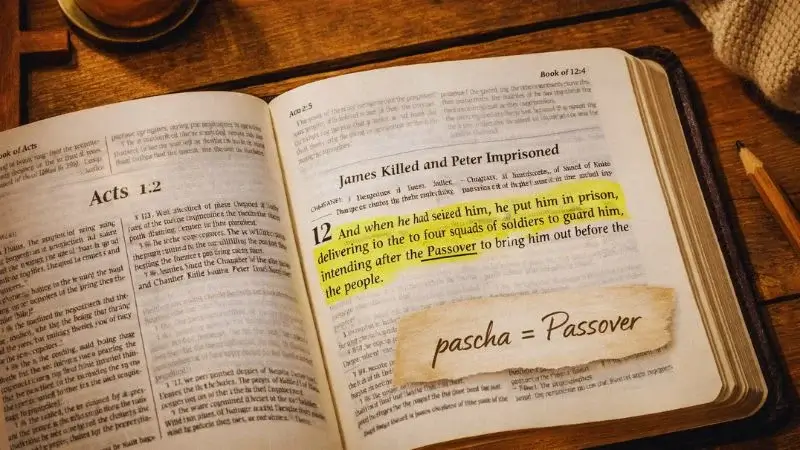
Here is something worth noting. Open your Bible and search for the word “Easter.” Depending on the translation, you may find it once. That single appearance is in Acts 12:4 in the King James Version, where “Easter” was used to translate the Greek word pascha.
Every modern translation renders that word as “Passover,” because that is what it means. Pascha is the Greek form of the Hebrew Pesach, meaning Passover. In other words, the earliest Christians did not see this as something new, but as the fulfillment of the Passover. This is the term the New Testament uses in the context of Jesus’ death and resurrection.
The word “Easter” does not appear in the original Greek text of the New Testament.
The early church did not call this day Easter. They called it Pascha, the Christian Passover. It marked the fulfillment of what the original Passover pointed to. The Lamb of God was slain and raised. That is the center of the message. Not a season, but a Savior.
That connection is beautiful. It is deeply biblical. And the name “Resurrection Sunday” reflects that truth more clearly than a name shaped later in history.
Where Did the Word “Easter” Come From? (Origins Explained)
This is where things get interesting, and where we need to tread carefully without being alarmist.
The origin of the word “Easter” is debated among historians. The English Christian monk Bede, writing in the 8th century, connected the word to a pagan spring goddess named Eostre. Some historians question whether this goddess ever existed as Bede described her. Others accept it. The debate continues.
What is less debatable is this: the customs we now associate with Easter, the eggs, the rabbits, the baskets, the focus on spring, have no roots in the New Testament. They come from folk traditions, seasonal celebrations, and cultural practices that were absorbed into the popular observance of the holiday over many centuries.
This does not mean every person who says “Easter” is unknowingly worshiping a pagan deity. Of course not. Words change meaning over time. Intentions matter. Most believers who say “Easter Sunday” mean the resurrection of Jesus, full stop.
But here is the gentle point worth sitting with: when the name we are using carries baggage that has nothing to do with Scripture, and when there is a name available that says exactly what we mean, why not use that better name?
Why “Resurrection Sunday” Is a More Biblical Name
The phrase “Resurrection Sunday” is not a theological invention. It is a description. It tells you exactly what happened on that day.
Jesus rose from the dead. On a Sunday. That is Resurrection Sunday.
It leaves no room for confusion. When you say, “Resurrection Sunday,” no one asks you what it has to do with eggs. The name carries its own explanation. It is a built-in witness to the truth of the gospel.
There is also something powerful about saying the word “resurrection” out loud. It is a declaration. When you greet someone with “Happy Resurrection Sunday,” you are essentially preaching a one-sentence sermon. You are telling them that a man was dead and is now alive. That death was defeated, and the grave did not win.
Paul told the Romans: “If you declare with your mouth, ‘Jesus is Lord,’ and believe in your heart that God raised him from the dead, you will be saved” (Romans 10:9). The resurrection is not a footnote to salvation. It is part of the proclamation itself.
What we call this day is part of how we proclaim it.
Is It Wrong to Say “Easter”? A Biblical Perspective
Now, let me be honest with you about something.
The Bible does not command us to call this day “Resurrection Sunday.” No verse says you are sinning if you say “Easter.” Paul made it clear in Romans 14 that believers have freedom regarding the observance of special days. “One person considers one day more sacred than another; another considers every day alike. Each of them should be fully convinced in their own mind” (Romans 14:5).
This is not a salvation issue. It is not a fellowship-breaking issue. It is a question of intentionality.
What are we communicating? What are we centering? And does the name we are using point people toward the truth, or does it point them toward something else?
I know many godly, Bible-believing pastors and Christians who still use the word Easter and mean every bit of it as a celebration of the risen Christ. I am not questioning their faith or their love for Jesus. Not for a moment.
But for me personally, once I saw it, I could not unsee it. Once I asked the question about Easter eggs, I could not stop asking questions. And the more I dug into Scripture, the more I found that the language of resurrection, of new life in Christ, of death defeated, was already right there waiting for me.
What Happens When You Start Saying “Resurrection Sunday”
Something subtle happens when you start saying “Resurrection Sunday.”
Your own heart begins to remember what the day is about. Every time you say it, you are rehearsing the gospel to yourself. You are not just naming a holiday. You are confessing a truth.
And it opens conversations.
People notice when you use a different language. They ask why. And suddenly you have an opening to tell them about an empty tomb, a risen Savior, and a faith built not on mythology or tradition, but on a historical event that changed the trajectory of human history.
I have had those conversations. They are not awkward. They are actually a gift.
When someone asks me, “Wait, why do you say Resurrection Sunday instead of Easter?” I get to say, “Because that’s what happened. Jesus rose from the dead, and I don’t want to call it anything that might distract from that.”
That is a witness. A gentle, natural one.
Key Takeaways
- The word “Easter” does not appear in the original biblical text. Every modern translation renders the Greek word pascha as “Passover.”
- The early church called this celebration Pascha, not Easter. It was rooted in the fulfillment of the Jewish Passover through the death and resurrection of Jesus.
- Common Easter traditions like eggs, bunnies, and baskets have no biblical origin. They come from cultural and folk traditions absorbed over centuries.
- “Resurrection Sunday” is a declaration, not just a label. Saying it is a built-in, one-sentence gospel witness.
- This is not a salvation issue. Romans 14:5 gives believers freedom regarding the observance of special days. The point is intentionality, not legalism.
- Shifting to “Resurrection Sunday” naturally opens gospel conversations with people who notice the difference and ask why.
Frequently Asked Questions
Is it a sin to say, “Easter Sunday”?
No. The Bible does not command a specific name for this day. Romans 14:5 shows that believers have freedom in how they observe special days. Saying “Easter” is not a sin.
Is Easter a pagan holiday?
Not exactly. The word “Easter” may have historical links to pre-Christian traditions, though this is debated. What is clear is that common customs like eggs and bunnies are not biblical. The resurrection of Jesus, however, is fully biblical.
Did the early church celebrate Easter?
Not by that name. Early Christians celebrated Pascha (Passover), focusing on the death and resurrection of Jesus as its fulfillment.
Where does the word “Easter” appear in the Bible?
It appears once in Acts 12:4 in the King James Version. The original Greek word is pascha, which means “Passover.” Modern translations reflect this correctly.
Why are eggs and bunnies associated with Easter?
They come from cultural and seasonal traditions, not the Bible. These symbols developed over time and are not connected to the resurrection of Jesus.
How can I talk about this without causing conflict?
Be gentle and lead by example. Use the language you prefer, and share your reasoning only when asked. Focus on edifying others, not correcting them.
What can I say instead of “Happy Easter”?
You can say “Happy Resurrection Sunday” or “He is risen!” Both clearly point to the resurrection of Jesus.
Easter or Resurrection Sunday? Holding Truth Without Division
Here is where I want to land.
Hold the name lightly. Do not make it a point of contention with other believers. Do not make people feel judged for saying Easter. That is not the spirit of this conversation.
But hold the truth firmly. Jesus Christ was raised from the dead. Bodily. Historically. Triumphantly. That truth is not negotiable. It is the anchor of everything we believe.
So, as this season approaches, consider the name you use. Not out of legalism, but out of love for what the name points to. Consider what it might look like to center your celebration, your greetings, your social media posts, your conversations, around the word that says it best.
Resurrection Sunday.
He is risen. That is the whole story.
And that story deserves a name that tells the truth.
“But Christ has indeed been raised from the dead, the firstfruits of those who have fallen asleep.” —1 Corinthians 15:20
And if you want to go deeper into what the resurrection means for your daily life, I’ve written more on that here.
This post contains affiliate links, which means I may earn a commission at no extra cost to you if you make a purchase through one of these links. I only recommend products or services I trust and personally use. Thank you for supporting Biblical Christianity!
Recommended Resource
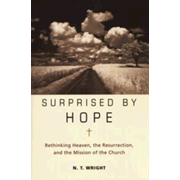
Explore the hope of Christ’s resurrection with N.T. Wright’s Surprised by Hope. This book shows how Jesus’ resurrection shapes our faith, our understanding of life after death, and the mission of the Church today. Perfect for deepening your reflections this season.
|
Surprised By Hope: Rethinking Heaven, The Resurrection, and The Mission of the Church
By N.T. Wright Wright convincingly argues that Christianity’s most distinctive idea is bodily resurrection. He provides a compelling defense for the literal resurrection of Jesus and explores its implications for our hope in the resurrection of all people and the renewal of creation. A thought-provoking resource for deepening your understanding of what the Resurrection truly means. |
All man-made holidays are pagan in origin. The only celebrations that aren’t are the three biblical feasts, which were made spiritual upon the death of the testator, Jesus Christ.
Colossians 2:14 (KJV)
14 Blotting out the handwriting of ordinances that was against us, which was contrary to us, and took it out of the way, nailing it to his cross!
Thank you for sharing your perspective, Clinton. I appreciate your desire to honor what is truly biblical.
You’re absolutely right that Christ fulfilled the law and that our salvation is not found in observing feasts or ordinances (Colossians 2:14 is a powerful reminder of that). As believers, we are no longer bound by ceremonial laws as a requirement for righteousness.
At the same time, it’s important to distinguish between what saves us and what helps us remember and proclaim the gospel.
Celebrating the resurrection of Jesus, whether someone calls it Resurrection Sunday or Easter, is not about returning to Old Covenant ordinances. It’s about rejoicing in the finished work of Christ, just as the early church regularly remembered His death and resurrection (see 1 Corinthians 15:3–4).
Regarding the idea that all man-made holidays are pagan, I would gently say that the meaning we give something matters. Many believers intentionally set aside this time not to adopt pagan practices, but to focus on the resurrection—the very foundation of our faith.
In the end, Scripture gives us freedom in these matters:
“One person esteems one day above another; another esteems every day alike. Let each be fully convinced in his own mind.” (Romans 14:5)
So, whether someone chooses to observe the day or not, what matters most is that Christ is honored, and the gospel is clearly proclaimed.
“Happy Resurrection Sunday” or “He is risen!”
I’m coming around to that real fast.
Amen!
And because Jesus lives, we can face tomorrow.
Jesus is risen; hence, our faith is not in vain.
Well said and well done. Jesus Christ is Risen, and He is LORD of ALL.
Amen, hallelujah!
We possess a vibrant hope because Jesus Christ is alive, now seated at the right hand of the Father.
Have a blessed Resurrection Sunday. ✝