

I grew up thinking I was a Christian.
I attended Mass every Sunday. I knew the prayers. I went through the rituals. That was enough, or so I believed.
Then someone shared the Gospel with me. And instead of simply receiving it, I found myself asking a different question.
Why are there so many Christian denominations?
My first instinct was to dismiss the question entirely. Catholicism had been around for centuries. Surely it had to be the one true church. Why would I even need to consider the others?
But the question did not go away. Even after I accepted Christ as my Lord and Savior, it kept coming back. When I shared the Gospel with others, they asked me the same thing. And I did not have a good answer.
Things got more confusing when pastors I knew left their churches to start their own congregations. If we all serve the same God and read from the same Bible, why are there so many different groups? Which ones are the true church? Which are false? And why would God allow so much division in the first place?
These are honest questions. And they deserve honest answers.
Here is what I have come to understand.
There are thousands of Christian denominations, but most share the same core Gospel—salvation by grace through faith in Jesus Christ. Differences usually center on secondary issues like baptism, church structure, and end times, not the essentials of salvation.
The Bible both warns that division will occur and calls believers to pursue unity in Christ. Denominations are not proof that Christianity is false. They reflect human limitations and sincere efforts to understand Scripture.
Do not let denominational differences distract you from Christ Himself.
What Is a Christian Denomination (and Why Are There So Many)?
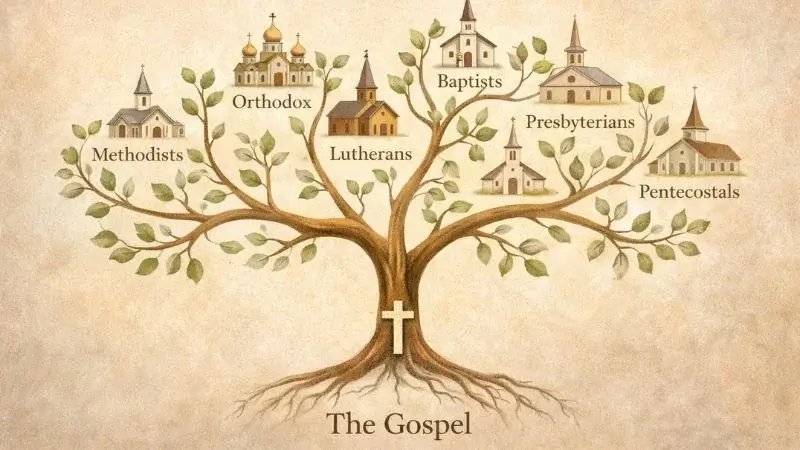
A denomination is simply a group of churches that share the same beliefs, structure, and practices. Think of it as a family of congregations gathered around a common set of convictions.
Baptists, Methodists, Lutherans, Presbyterians, Pentecostals, and yes, Catholics, are all denominations. They differ in certain ways. But many of them share the same core Gospel.
Different denominations do not necessarily mean different religions. They often mean different expressions of the same faith.
That distinction matters. It changes how we see the whole conversation.
Core Doctrines vs. Secondary Issues: The Most Important Distinction
Not all disagreements between Christians carry the same weight. There is a difference between the things every true Christian must believe and the things Christians can reasonably interpret differently.
Core doctrines are non-negotiable. These include:
- The Trinity: God as Father, Son, and Holy Spirit
- The full deity and humanity of Jesus Christ
- Salvation by grace through faith alone
- The authority and reliability of Scripture
These define true Christianity. A church that rejects these core truths steps outside historic, biblical Christianity, regardless of what name is on the building.
Then there are secondary issues, where sincere, Bible-believing Christians have disagreed for centuries:
- Baptism: infant or believer’s baptism?
- Church governance and leadership structure
- The role of spiritual gifts today
- Views on the end times
When you understand this distinction, the confusion starts to clear.
This is the key insight: denominations often exist not because Christians follow different gospels, but because they interpret secondary issues differently.
That does not make those differences trivial. But it does mean that two people in different denominations can both be genuinely saved and genuinely serving the same Christ.
Why Are There So Many Christian Denominations? A Brief History
The early church was not without conflict. Even in the book of Acts, we see disagreements among believers. But the church remained largely unified around core doctrine for its first several centuries.
Over time, disputes arose over theology, authority, and practice. Some divisions were painful. Some were necessary.
The most significant turning point was the Protestant Reformation in the 1500s. Reformers like Martin Luther and John Calvin did not set out to create new denominations. They wanted to call the church back to Scripture. When the institutional church refused to reform, new communities of faith formed around biblical truth.
As Christianity spread through missions and across cultures, new expressions of the faith emerged. Different communities, different languages, different histories, different emphases. The result was a wide variety of denominations.
Not every split was noble. Some came from pride or ambition. But many came from a genuine desire to protect truth and follow God faithfully.
Does the Bible Predict Division in Christianity?

Yes. And that is not a flaw in Scripture. It is a sign of its honesty.
The Bible warned that division would come. Paul told the Ephesian elders that false teachers would rise from within the church itself (Acts 20:29-30). He rebuked the Corinthians for splitting into factions based on which leader they preferred (1 Corinthians 1:10-13). Peter warned of false prophets who would introduce destructive heresies (2 Peter 2:1).
The New Testament never painted a picture of a perfectly unified institutional church. It warned us that division would be part of the story.
But the Bible also calls us to pursue unity. Jesus prayed that His followers would be one, so the world would know that the Father sent Him (John 17:21). Paul urged believers to make every effort to keep the unity of the Spirit (Ephesians 4:3-6).
These two truths hold together. Division is real and often sinful. But separation for the sake of truth can also be necessary and right.
The Bible predicting division does not mean God approves of all division. It means God is not surprised by it. He told us the truth about what would happen.
Are Denominations Biblical? Not All Divisions Are the Same
This is where it helps to make a distinction.
Some divisions are sinful. They come from pride, power struggles, personal offense, or the desire for control. This is what Paul condemned in Corinth. It is what we see when churches split over personality conflicts or petty disagreements. It dishonors Christ and confuses the world.
Other divisions are faithful. They come from a commitment to biblical truth when a church or institution has drifted into error. The Reformers did not split from Rome for fun. They did so because the Gospel itself was at stake.
Think of it this way. A family can have many branches without falling apart. Different households, different styles, different rhythms of life. But they share the same bloodline, the same name, and the same roots.
Denominations, at their best, are like that. Different families within the same household of faith. Connected not by an institution but by the Gospel of Jesus Christ.
The question to ask about any denomination is not simply whether it exists. The question is whether it holds true to the core Gospel. Everything else flows from there.
By the Gospel, we mean the good news that Jesus Christ, fully God and fully man, died for our sins and rose again, and that we are saved by grace through faith in Him alone.
How Should Christians View Denominations Today?
I remember how disorienting it was to see pastors leave to start their own churches. It felt like evidence that something was deeply wrong. Maybe Christianity itself could not be trusted.
But I have come to see it differently. Human beings are imperfect. Leaders fail. Institutions drift. That is not a reason to abandon Christ. It is a reason to keep our eyes on Him.
Here is practical guidance for navigating denominations:
- Do not panic. The existence of many denominations does not mean Christianity is false. It means Christians are human.
- Focus on the Gospel first. Ask whether a church preaches salvation by grace through faith in Jesus Christ alone. That is the starting point.
- Look for a church that teaches Scripture faithfully, centers on Christ, and produces genuine spiritual growth in its people.
- Practice discernment, not cynicism. Not every difference is a dealbreaker. Not every similarity means a church is safe.
The goal is not to find a perfect church. It is to find a faithful one.
True Unity in Christ Does Not Require One Institution
Here is what the Bible makes clear. True Christian unity is not institutional. It is spiritual.
Paul wrote that there is one body, one Spirit, one hope, one Lord, one faith, one baptism, one God and Father of all (Ephesians 4:4-6). That unity already exists in Christ. It is not something we create by merging organizations. It is something we preserve by holding to the same Gospel and walking in love.
A Baptist pastor in Nigeria, a Presbyterian elder in South Korea, and a Pentecostal believer in the Philippines may never meet. They may worship very differently. But if they trust the same Christ, they are one in Him.
That unity is real. It is deep. And no amount of denominational diversity can break it.
Denominations Are Not a Reason to Doubt Christ
When I was struggling to surrender my life to Christ, the question of denominations felt like a wall. It gave me something to hide behind. If I could not figure out which church was right, maybe I did not have to decide anything at all.
But eventually I realized that the question of denominations, while worth understanding, was separate from the question of Christ Himself.
Jesus did not say, “Come to the right denomination.” He said, “Come to me.”
Denominations reflect human limitations. They reflect sincere but imperfect attempts to understand and apply Scripture. Some are healthier than others. Some have drifted. Some are thriving.
But none of that changes who Jesus is. None of it changes the Gospel.
If you are asking why Christians disagree, the honest answer is: because we are human, because Scripture requires interpretation, and because the enemy has always worked to divide what God is building.
But do not let the complexity of denominations distract you from the simplicity of Christ.
He is not divided. He is not confused. And His invitation to you is clear.
Do not let the noise of human disagreement drown out His voice.
Key Takeaways
- A denomination is a group of churches sharing common beliefs and practices, not a separate religion.
- Core doctrines like the Trinity, the deity of Christ, and salvation by grace are non-negotiable and shared across true Christian denominations.
- Denominations differ mainly on secondary issues, which sincere Bible-believing Christians have debated for centuries.
- The Bible predicted division and warned against it, but also calls all believers to pursue unity in the Spirit.
- Not all divisions are sinful. Some separation exists to protect biblical truth.
- True Christian unity is spiritual, not institutional. Believers across denominations are one in Christ.
- Choose a church that teaches Scripture faithfully, centers on Christ, and produces genuine spiritual growth.
Frequently Asked Questions
Why are there so many Christian denominations?
Denominations formed over centuries through theological disputes, cultural differences, mission growth, and efforts to reform the church. Not every split was sinful. Many came from sincere attempts to follow Scripture faithfully.
Does the Bible predict division in Christianity?
Yes. The New Testament warned that false teachers would arise from within the church and that people would divide over leaders and doctrine. But Scripture also calls believers to pursue unity in the Spirit.
Are denominations biblical?
The Bible does not endorse denominations as a system, but it does acknowledge that division would happen. What matters is whether a church holds to the core Gospel of Jesus Christ.
Do denominations matter for salvation?
No. Salvation is not found in a denomination but in Jesus Christ. What matters is whether a person has truly trusted in Him for salvation by grace through faith.
Why do Christians disagree on so many things?
Christians agree on the essentials of salvation. Most disagreements are over secondary issues that require interpretation of Scripture. Human limitation, cultural context, and differing theological traditions all play a role.
Which denomination is the true church?
No single denomination perfectly represents the fullness of biblical truth. The true church is made up of all genuine believers in Jesus Christ, across many traditions and backgrounds, united by the same Gospel.
How do I choose the right church?
Start with the Gospel. Find a church that teaches Scripture faithfully, preaches salvation by grace through faith in Christ alone, and produces real spiritual growth in its people. Secondary distinctives matter, but the Gospel comes first.
This post contains affiliate links, which means I may earn a commission at no extra cost to you if you make a purchase through one of these links. I only recommend products or services I trust and personally use. Thank you for supporting Biblical Christianity!
Recommended Resource
If you want to better understand the core doctrines of the Christian faith and why believers sometimes disagree on secondary issues, a helpful resource is Systematic Theology by Wayne Grudem. It clearly explains what the Bible teaches on essential doctrines while also addressing areas where Christians hold different views.
|
Systematic Theology: An Introduction to Biblical Doctrine, Second Edition
By Wayne Grudem If theology has ever felt overwhelming or difficult to understand, this updated edition of Systematic Theology by Wayne Grudem makes biblical doctrine clear and accessible. It explains essential Christian beliefs with strong scriptural support and practical application. This resource is especially helpful for understanding core doctrines and why Christians sometimes differ on secondary issues—making it a perfect companion for growing in discernment and confidence in God’s Word. |