
There was a time when my Bible reading felt scattered.
I would open my Bible with good intentions, read a passage, then quickly move to something else. One chapter in the Gospels, a few verses in the Psalms, maybe something from Paul’s letters the next morning. I was reading God’s Word, but not really studying it. And if I’m honest, very little of it stayed with me.
It wasn’t a lack of desire. I genuinely wanted to grow. But without a clear approach, my time in Scripture felt more like flipping through pages than actually understanding what God was saying.
Maybe you’ve felt that too. You sit down for your quiet time, unsure where to begin or how to go deeper. You read, but it feels surface-level. You want more, but you’re not sure how to get there.
That’s exactly where the inductive Bible study method changed things for me.
Instead of jumping from one passage to another, it helped me slow down, stay in the text, and actually see what was there. It gave structure to my study without making it complicated. Over time, it turned my daily devotions into something far more meaningful.
In this guide, I’ll walk you through how to use inductive Bible study in your daily devotions, step by step. So, you can move from simply reading the Bible to truly understanding and applying it.
What Is Inductive Bible Study? (Simple Bible Study Method Explained)
So, what exactly is inductive Bible study, and why does it make such a difference? Inductive Bible study is a method that starts with the text itself.
Instead of bringing your assumptions or feelings to a passage first, you let the Scripture speak on its own terms. You observe what’s there, figure out what it means, then decide how it applies to your life.
It really is that simple: observation, interpretation, and application.
It’s called “inductive” because you’re drawing conclusions from what you see in the text, rather than reading the text to confirm what you already believe. That difference matters more than it might seem at first.
The goal isn’t to become a professional theologian. It’s to understand God’s Word accurately and live it out faithfully.
The 3 Steps of the Inductive Bible Study Method
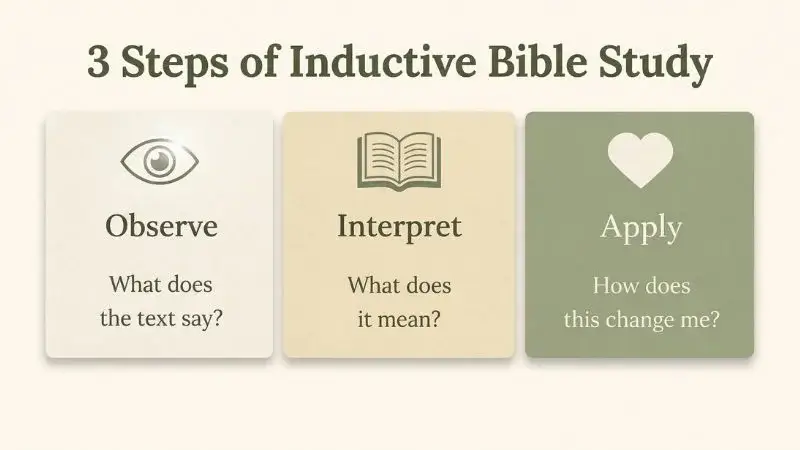
Step 1: Observation – What Does the Text Say?
This is where everything begins. Before you try to figure out what a passage means, you need to see exactly what it says.
Read the passage slowly. Then read it again.
Ask simple questions as you go:
- Who is speaking or being spoken to?
- What is happening or being commanded?
- When and where does this take place?
- Are there repeated words or phrases?
- What stands out or seems unusual?
The goal here is pure observation. You’re not trying to interpret yet. You’re just paying attention.
For example, in Philippians 4:6, you might notice “anxiety” contrasted with “prayer,” three actions (prayer, supplication, thanksgiving), and the promise of God’s peace in verse 7. Write these things down. Don’t skip this step.
Most people rush through observation because they’re eager to get to the “meaning.” But what you see in the text determines everything that comes after.
Step 2: Interpretation – What Does the Text Mean?
Once you’ve observed what the text says, the next step is to understand what it means. This step protects you from misreading Scripture or taking verses out of context.
At this stage, context is everything. A passage doesn’t stand on its own; it’s part of a bigger picture.
Here are three key areas to consider:
Literary context. What comes before and after this passage? Who is the author? Who is the original audience? What kind of writing is this: letter, poetry, or narrative?
Historical context. What was happening when this was written? What would the original readers have understood that we might miss today?
Biblical context. What do other parts of Scripture say about this topic? The Bible interprets itself, and a difficult passage often becomes clearer when compared with a clearer one.
This is where tools like a study Bible or Bible dictionary can help. You don’t have to be a scholar, but you do need to be careful. Keep asking: What did this mean to the original audience? That’s your foundation before asking what it means for you.
Good interpretation takes time, and that’s okay. The goal isn’t speed; it’s accuracy. And accuracy leads to real transformation.
Step 3: Application – How Does This Apply to My Life?
This is where study becomes personal.
But here’s where many people go wrong. Application isn’t just “be nicer” or “trust God more.” Those are fine thoughts, but they’re too vague to act on.
A good application is specific. It answers questions like:
- Is there a sin I need to confess or turn from?
- Is there a promise I need to believe and rest in?
- Is there a command I need to obey this week?
- Is there something about God’s character I need to remember?
If you’ve studied Philippians 4:6-7, your application might be: “Tonight when I start worrying about that situation at work, I’m going to write out a prayer of thanksgiving before I go to sleep.” That’s something you can actually do.
Application connects your study to real life. Without it, Bible study stays in your head and never reaches your hands and feet.
Don’t worry if this feels new. We’ll walk through a full example together in a moment.
How to Apply Inductive Bible Study in Daily Devotions

One of the biggest reasons people don’t stick with Bible study is that they think it has to be long. It doesn’t. Here are three ways to fit inductive study into your actual day.
A Simple 10-Minute Inductive Bible Study Routine
Pick one short passage. Three to five verses is enough.
Read it twice. Spend two to three minutes just observing: What do I see? Who is speaking? What words repeat? Jot a few notes.
Spend three to four minutes on interpretation: What does this mean? What is God saying here?
End with one minute of application: What is one thing I can do or believe differently today because of this?
That’s it. Ten minutes. Short and focused will always beat long and distracted.
A Deeper 20-30 Minute Bible Study Routine
If you have more time, use it to go slower, not to cover more ground.
Start with five minutes of observation, reading the passage multiple times and writing down everything you notice. Use a notebook or journal.
Spend ten to fifteen minutes on interpretation. Cross-reference related verses. Read a short commentary note. Think carefully about context.
Close with five to ten minutes on application and prayer. Write out what you’re learning and talk to God about it.
This deeper version is great for days off, mornings before work, or whenever you can carve out uninterrupted time.
A Real-Life Routine for Busy Days
Some days, the morning gets away from you. The kids are loud, work is pulling at you before you’ve even had coffee, or you’re just tired.
On those days, grace matters more than guilt.
Even five minutes with one verse, truly slow and attentive, is better than skipping altogether. Bring your Bible to lunch. Listen to a passage on audio during your commute. Study one verse with your spouse before bed.
Consistency over time is what shapes us. Not perfection every morning.
Inductive Bible Study Example (Step-by-Step for Beginners)
Let’s walk through Philippians 4:6-7 together.
“Do not be anxious about anything, but in everything by prayer and supplication with thanksgiving let your requests be made known to God. And the peace of God, which surpasses all understanding, will guard your hearts and your minds in Christ Jesus.”
Observation Example
Here’s what you might notice when you slow down and look carefully:
Paul gives a command: “Do not be anxious about anything.” The word “anything” is absolute. There’s no exception.
He then gives a contrast. Instead of anxiety, we’re told to bring our concerns to God through prayer and supplication, with thanksgiving attached.
Three actions: prayer, supplication, and thanksgiving. Not just asking. Thanking.
The result is God’s peace, and this peace is described as surpassing understanding. Paul says it will “guard” our hearts and minds. That’s a military image. A sentinel standing watch.
Interpretation Example
Paul is writing from prison (Philippians 1:7). He’s not writing from a comfortable life. He’s writing from chains.
That matters. His command to stop worrying is not naive or disconnected from hardship. He’s living it.
The Greek word for “supplication” refers to specific, earnest requests. This isn’t casual prayer. It’s bringing a particular need before God with urgency. The addition of thanksgiving shifts the posture of prayer from a complaint to an act of faith. You’re thanking God even before the answer comes.
The peace that follows isn’t simply a calm feeling. It’s a peace that guards, actively protecting the mind against the damage anxiety causes.
Application Example
After studying this passage, a real application might look like this:
“I’ve been anxious about my health situation and haven’t talked to God specifically about it. Tonight, I’m going to write out my exact fears and bring them to God in prayer, and I’m going to include three things I’m thankful for. I’ll trust Him to guard my mind.”
That’s specific and actionable. That’s what inductive Bible study makes possible.
Common Mistakes to Avoid in Inductive Bible Study
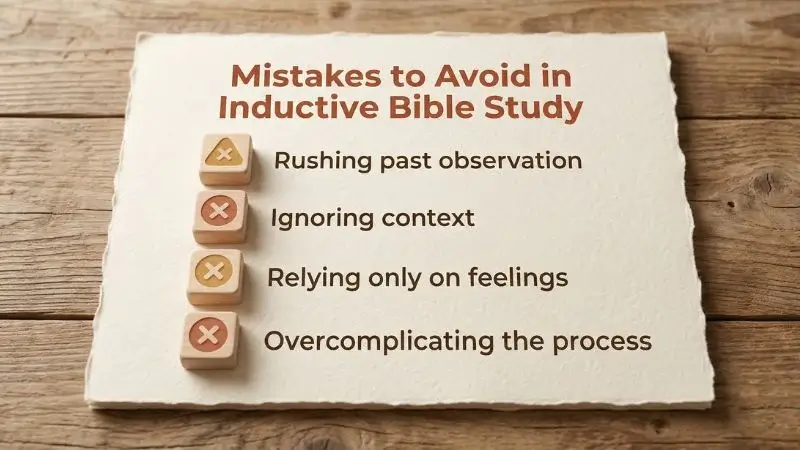
Skipping observation and rushing to meaning.
If you don’t see what’s actually there, your interpretation won’t be grounded. Slow down.
Ignoring context.
A verse lifted out of its surrounding passage can be made to say almost anything. Always read what comes before and after.
Relying only on feelings.
“This verse makes me feel hopeful” is a starting point, not a destination. Let the text anchor your feelings, not the other way around.
Overcomplicating the process.
You don’t need a theology degree to do this well. The method is simple on purpose. Trust the process and stay consistent.
Helpful Tools for Inductive Bible Study
You don’t need many tools. But a few go a long way.
A good study Bible gives you historical context, cross-references, and brief notes right on the page. A concordance helps you find how a word is used elsewhere in Scripture. A reliable Bible app can give you access to multiple translations and commentaries wherever you are.
Keep it simple. The goal is to spend more time in the text, not more time managing resources.
If you want a more complete list, take a look at my guide on the best Bible study tools and apps for deeper Scripture study.
Inductive Bible Study vs. the SOAP Method: What’s the Difference?
Both methods follow a similar shape. SOAP stands for Scripture, Observation, Application, and Prayer. (If you’re new to it, you can read my guide on using the SOAP method for personal Bible reflection.)
The main difference is that inductive Bible study places a stronger emphasis on interpretation as its own dedicated step. It pushes you to ask what the text meant before asking what it means for you. SOAP is often faster and more devotional in tone.
Neither is wrong. If SOAP has been working for you, inductive study will deepen it. If you’re new to structured Bible study, starting with inductive gives you a strong foundation.
Frequently Asked Questions About Inductive Bible Study
Q1: Is inductive Bible study only for serious students of the Bible?
Not at all. It’s designed to help everyday believers read Scripture carefully. The steps are simple enough for a new Christian and rich enough for someone who’s studied for years. You don’t need seminary training; just a Bible, a notebook, and a willingness to slow down.
Q2: How long should I spend on each step?
It depends on your time. In a 10-minute session, spend 3–4 minutes on observation, 3–4 on interpretation, and 2 on application. In a longer session, interpretation naturally takes more time. Let the passage guide you.
Q3: Can I use this method with any book of the Bible?
Yes. It works for letters, Psalms, Gospels, Proverbs, prophecy, or any genre. The questions you ask in observation may vary, but the three-step structure stays the same.
Q4: What if I don’t understand a passage during interpretation?
That’s normal; it means you’re taking the text seriously. Use a study Bible, commentary, or compare translations. Sometimes sitting with a passage for a few days brings clarity.
Q5: Do I need to journal to use this method effectively?
Journaling helps, but it’s not required. You can underline, use sticky notes, or even talk through the passage aloud. The goal is engagement, not a specific format.
Q6: How is this different from reading a devotional?
A devotional provides someone else’s interpretation and application. Inductive Bible study puts you directly in the text to see and understand it for yourself. Both are useful, but one builds your insight, while the other relies on someone else’s.
Key Takeaways
- Observe, interpret, apply. Always in that order. Observation is the foundation.
- See clearly first. Don’t rush past what the text actually says.
- Interpret carefully. Ask what the passage meant for its original audience before asking what it means for you.
- Apply specifically. Make it actionable. Avoid vague ideas like “trust more.”
- Time doesn’t matter. You can study in 10 minutes or 30. Consistency beats length.
- Small steps count. Even five focused minutes with one verse is enough on busy days.
- Purpose: To know God better through His Word and live it out faithfully.
Final Thoughts: Growing Deeper in God’s Word One Step at a Time
Depth doesn’t come all at once. It comes from sitting with the same passage long enough to see what you missed the first time.
If you try this method this week and it feels awkward, that’s normal. Any new skill does. Keep going. The goal isn’t a perfect study session. It’s a growing familiarity with God’s voice through His Word.
Be patient with yourself. Be consistent. And trust that God honors the effort of a heart that genuinely wants to know Him.
You don’t have to master this overnight.
Start Your Inductive Bible Study Today
You don’t need anything special to begin.
Pick a short passage. Philippians 4:6-7 works great. Or try Psalm 23. Or one of the Proverbs.
Work through the three steps: observe what the text says, interpret what it means, and apply it to your life today.
Do that again tomorrow, and the day after.
That’s how ordinary Bible readers become people who know God’s Word deeply. Not by doing something extraordinary, but by doing something simple, faithfully, over time.
This post contains affiliate links, which means I may earn a commission at no extra cost to you if you make a purchase through one of these links. I only recommend products or services I trust and personally use. Thank you for supporting Biblical Christianity!
Recommended Resource
If you want something specifically designed for this method, I personally recommend using an inductive study Bible. It gives you space to observe, take notes, and engage with the text without relying too quickly on commentary.
|
NASB New Inductive Study Bible, Hardcover
Updated NASB Translation The New Inductive Study Bible is designed to help you study Scripture for yourself using the inductive method. Instead of relying on commentary, it guides you to observe, interpret, and apply God’s Word directly from the text. With wide margins for note-taking, step-by-step study guidance, and helpful charts and references, this Bible makes it easier to slow down, stay in the passage, and grow in understanding over time. |