

If you grew up in church, you probably heard the word “Antichrist” thrown around a lot. Maybe it was whispered during a Sunday school lesson. Maybe it showed up in a sermon about the end times. Maybe someone in your life was convinced they knew exactly who it was.
I remember sitting through more than a few conversations where people were dead certain the Antichrist was some current world leader. Every election cycle, every global crisis, every new technology seemed to bring another confident prediction. And every time, the prophecy fizzled.
The problem isn’t that Christians care about Bible prophecy. Scripture encourages us to be watchful and discerning. The problem is that many ideas about the Antichrist come from novels, movies, prophecy charts, and internet speculation rather than careful Bible study.
Some Christians are surprised to learn that the word “Antichrist” appears only a handful of times in Scripture and never once in the book of Revelation.
That fact alone should make us pause and ask an important question: What does the Bible actually say?
This article is a return to the text. We’ll look at what the Bible actually says, where the myths come from, and how believers are called to respond.
The word “Antichrist” appears only in John’s letters, not in Revelation. Scripture warns that many antichrists and the spirit of antichrist are already active in the world, opposing the truth about Jesus Christ. While some biblical passages may point to a future end-times figure, the Bible’s primary focus is not on identifying the Antichrist but on remaining faithful to Christ, who has already secured the ultimate victory.
What Does the Word “Antichrist” Mean?
The word “Antichrist” comes from the Greek antichristos. It carries two layers of meaning.
First, “anti” can mean against. An antichrist opposes Christ directly.
Second, “anti” can also mean in place of. An antichrist presents itself as a substitute or counterfeit messiah.
Both meanings matter. The antichrist isn’t just a hostile enemy of Jesus. It’s something that mimics him while undermining him.
Where Does the Bible Mention the Antichrist?
Here’s a fact that surprises many people: the term “Antichrist” appears in only four verses in the entire Bible, all written by the apostle John.
- 1 John 2:18 — “Children, it is the last hour, and as you have heard that antichrist is coming, so now many antichrists have come. Therefore, we know that it is the last hour.”
- 1 John 2:22 — “Who is the liar but he who denies that Jesus is the Christ? This is the antichrist, he who denies the Father and the Son.”
- 1 John 4:3 — “And every spirit that does not confess Jesus is not from God. This is the spirit of the antichrist, which you heard was coming and now is in the world already.”
- 2 John 7 — “For many deceivers have gone out into the world, those who do not confess the coming of Jesus Christ in the flesh. Such a one is the deceiver and the antichrist.”
That’s it. John is the only biblical author who uses this word. It never appears in Revelation. It never appears in Daniel. It never appears in 2 Thessalonians.
This doesn’t mean those other passages are unrelated. But it does mean we need to be careful about which concepts we’re actually reading from Scripture versus which ones we’re importing from elsewhere.
Why Do So Many People Think the Antichrist Is in Revelation?
If the word Antichrist never appears in Revelation, why do so many Christians automatically associate the two?
The answer is understandable. Revelation contains a frightening figure known as the Beast, described in Revelation 13 as a powerful ruler who opposes God, persecutes His people, and receives authority from the dragon (Satan). The Beast deceives the nations, demands allegiance, and becomes a central figure in the book’s end-times events.
Because these actions resemble what many Christians associate with the Antichrist, believers throughout church history have often connected the Beast of Revelation with the Antichrist mentioned in John’s letters. Many also link both figures to Paul’s “man of lawlessness” in 2 Thessalonians 2 and Daniel’s “little horn” in Daniel 7. As a result, these passages are frequently woven together into a single end-times portrait.
Over time, the terms Antichrist and the Beast became almost interchangeable in popular Christian teaching, books, movies, and prophecy conferences. When most people hear the word “Antichrist,” they immediately picture the Beast of Revelation.
That connection may be reasonable. There are certainly similarities between these figures, and many faithful Bible scholars believe they ultimately refer to the same person. However, it’s important to recognize what the Bible explicitly says and what we infer from comparing passages.
Scripture clearly describes both the Antichrist and the Beast. What it does not explicitly do is state, “The Antichrist is the Beast.” That conclusion may be correct, but it is a conclusion drawn from synthesizing several passages rather than from a direct biblical statement.
Recognizing that distinction helps us approach prophecy with both conviction and humility. We can hold our views confidently while also acknowledging where Scripture leaves room for discussion.
The Bible Says There Are Many Antichrists
John’s Warning to the Early Church
When John wrote “even now many antichrists have come,” he wasn’t describing a future event. He was describing his present. First-century believers were already surrounded by antichrist figures.
This is an important observation. In John’s writings, the antichrist is not only a future concern. It is also a present spiritual reality.
How Were Antichrists Already Present?
John identifies them clearly. Antichrists are people who:
- Deny that Jesus is the Christ (1 John 2:22)
- Deny the Father and the Son (1 John 2:23)
- Deny that Jesus Christ has come in the flesh (2 John 7)
These were false teachers. They had once been part of the community and then left, spreading doctrine that undermined the person and work of Jesus. They weren’t just theologically mistaken. John calls them liars and deceivers.
What Christians Can Learn Today
The same patterns exist now. Any teaching that denies the full deity of Christ, the full humanity of Christ, or the sufficiency of his atoning work carries the spirit of antichrist.
This isn’t political. It’s doctrinal. The threat John warns about is found in churches and theological systems, not just in world headlines.
What Is the Spirit of Antichrist?
Understanding 1 John 4:3
John writes that “every spirit that does not acknowledge Jesus is not from God. This is the spirit of the antichrist, which you have heard is coming and even now is already in the world.”
Notice two things. First, the spirit of antichrist was already active when John wrote. Second, John connects it to a specific spiritual test: does this spirit acknowledge Jesus?
How the Spirit of Antichrist Operates
It works in several ways.
It denies Christ’s deity. Any teaching that reduces Jesus to a moral teacher or a prophet while stripping him of his divine nature reflects this spirit.
It denies Christ’s humanity. Some early heresies taught that Jesus only appeared to be human. John is writing against exactly this kind of distortion.
It rejects the gospel. Wherever the substitutionary atonement of Christ is minimized or replaced, the spirit of antichrist is at work.
In some cases, the spirit of antichrist appears openly hostile to Christianity. In other cases, it appears religious and spiritual while quietly redefining who Jesus is. That is often what makes deception so dangerous. Counterfeits rarely announce themselves as counterfeits.
Why Discernment Matters More Than Ever
The spirit of antichrist doesn’t always look threatening. Often it looks appealing. It speaks in the language of love, tolerance, and progress while emptying the gospel of its content.
Believers need theological grounding, not just cultural savvy, to recognize it.
At this point, an important question remains. If John says there are many antichrists and that the spirit of antichrist is already at work in the world, does the Bible also point to one final Antichrist who will appear before Christ returns?
Many Christians believe the answer is yes. While several key passages never use the title “Antichrist,” they describe a powerful end-times opponent of God whom many scholars connect with John’s teaching.
Is the Bible Referring to a Future Antichrist?
Why Many Christians Believe So
Many Bible-believing Christians hold that Scripture does point to a future individual who will embody antichrist opposition to Christ on a global scale. This view deserves a fair hearing, not dismissal.
John himself says, “the antichrist is coming,” which could suggest a singular future figure. Other passages seem to describe a uniquely powerful end-times opponent of God.
The Antichrist and the “Man of Lawlessness”
Paul describes a figure in 2 Thessalonians 2:3-12 whom he calls “the man of lawlessness.” This person will exalt himself above God, claim to be God, and deceive many before being destroyed by Christ’s return.
Paul never uses the word “Antichrist” here. But the parallels are striking, and many theologians connect the two. For more on what currently restrains this figure, see our article on the Restrainer in 2 Thessalonians 2.
The Antichrist and Daniel’s Prophecies
Daniel 7 describes a “little horn” that speaks arrogantly, wages war against God’s people, and attempts to change times and laws. Daniel 9 describes a coming ruler who desolates and breaks the covenant.
These prophecies have layers. Some were fulfilled in historical figures like Antiochus Epiphanes. Others seem to reach beyond any single historical event, pointing to something yet to come.
Is the Antichrist the Same as the Beast?
Why Many Christians Equate Them
The connection is understandable. Both oppose Christ. Both deceive. Both have global reach. The progression from John’s antichrist to Revelation’s beast feels natural, and many systematic theologies treat them as the same figure.
What the Bible Explicitly Says
Revelation describes the Beast. John’s letters describe the Antichrist. Neither text explicitly identifies them as the same person.
What the Bible Does Not Explicitly Say
Scripture does not explicitly state that the Antichrist equals the Beast equals the Man of Lawlessness. These may all refer to one figure. They may describe overlapping but distinct realities.
Humility is appropriate here. Holding a view is fine. Presenting your view as the only possible reading is not.
Common Myths About the Antichrist
Myth #1: The Antichrist Is Mentioned Throughout Revelation
The word never appears in Revelation. This surprises almost everyone who hears it for the first time. The book describes beasts, a false prophet, a dragon, and enemies of God. But “Antichrist” is never the term used.
Myth #2: Every Powerful World Leader Is the Antichrist
Throughout church history, Christians have identified countless figures as the Antichrist, including Nero, various popes, Napoleon, Hitler, Mussolini, Henry Kissinger, Mikhail Gorbachev, and several modern political leaders.
All of these identifications failed. The track record should produce humility, not more confident predictions.
Myth #3: The Antichrist Will Be Easy to Recognize
Scripture emphasizes deception above all else. The antichrist spirit works by appearing credible, even appealing. If the Antichrist were obviously evil, he wouldn’t deceive anyone. Deception requires subtlety.
Myth #4: Christians Should Obsess Over Identifying Him
Spending more time identifying the Antichrist than knowing Christ is a misplaced priority. The Bible calls believers to watch, pray, stand firm in sound doctrine, and love one another. It does not call them to endless prophetic speculation.
Myth #5: The Antichrist Is the Main Character of Bible Prophecy
He is not. Jesus is. The entire arc of biblical prophecy culminates in Christ’s victory, reign, and the renewal of all things. The Antichrist is a defeated opposition character in a story whose ending is already written.
What Should Christians Focus on Instead?
Knowing Christ Rather Than Fearing the Antichrist
John’s letters are written to produce confidence, not anxiety. “Greater is he who is in you than he who is in the world” (1 John 4:4). The antidote to fear of the antichrist is a deep, settled knowledge of Christ.
Holding Firm to Sound Doctrine
The most practical protection against antichrist teaching is theological literacy. Read your Bible. Study the creeds. Know what you believe and why. Don’t outsource your theology to popular books, conferences, or online personalities. Test every teaching against Scripture.
Remaining Faithful Until Christ Returns
Whether Christ returns in your generation or not, the call is the same: be faithful. Serve your church. Love your neighbor. Endure hardship. Keep preaching the gospel. These are not passive activities.
Testing Every Teaching Against Scripture
“Beloved, do not believe every spirit, but test the spirits to see whether they are from God” (1 John 4:1). Every teacher, every movement, every trend in the church should be tested against Scripture. This is not cynicism. It’s obedience.
Frequently Asked Questions About the Antichrist
Is the Antichrist alive today?
No one knows. Scripture doesn’t give us a timetable. Christians throughout history have been convinced the Antichrist was alive in their day. Speculation on this point is unwarranted.
Is the Antichrist the Beast in Revelation?
Many theologians believe so, but the Bible never explicitly equates them. Both figures oppose Christ. Whether they are the same individual is debated among serious Bible scholars.
What is the spirit of antichrist?
It’s the spiritual disposition that denies the person and work of Jesus Christ. John says it was already at work in the first century and continues today.
Can Christians know who the Antichrist is?
Not with certainty. The consistent track record of failed identifications throughout church history should restrain confident claims.
Does the Bible say the Antichrist will rule the world?
Revelation describes the Beast as having great authority over the nations. But how literally or globally this plays out is a matter of ongoing debate in prophecy scholarship.
What should Christians do instead of speculating about the Antichrist?
Know Christ deeply. Hold to sound doctrine. Discern false teaching. Remain faithful. That’s the consistent call of Scripture.
Conclusion: The Bible Calls Us to Follow Christ, Not Chase Speculation
I’ll be honest with you. I’ve seen what end-times obsession can do to people. It produces anxiety instead of faith, division instead of unity, and a fixation on headlines instead of Jesus.
That doesn’t mean prophecy doesn’t matter. It does. But it was never meant to fuel fear or speculation. It was given to strengthen hope, encourage endurance, and deepen worship of the God who holds the future.
Here’s what Scripture gives us. Antichrists have existed since the early church. The spirit of antichrist is still at work wherever Christ is denied or distorted. Many Christians believe a future individual will embody this rebellion on an unprecedented scale.
But the focus of Scripture is not the rise of the Antichrist. It is the reign of Christ. The story of the Bible is centered on a King who conquered sin and death and who will one day return in glory.
The purpose of prophecy is not to help us identify every enemy. It is to help us remain faithful to Christ until He comes.
Keep your eyes on Him.
Related Reading
If you’d like to study these topics further, you may also enjoy our articles on the Rapture and Second Coming, the Day of the Lord, and the Millennium.
This post contains affiliate links, which means I may earn a commission at no extra cost to you if you make a purchase through one of these links. I only recommend products or services I trust and personally use. Thank you for supporting Biblical Christianity!
Recommended Resource
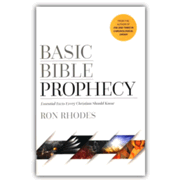
If you’d like a deeper, Scripture-based introduction to Bible prophecy without the sensationalism that often surrounds the topic, Basic Bible Prophecy by Ron Rhodes is an excellent place to start. It explains key end-times events and figures while keeping the focus where it belongs: on Christ and His promises.
|
Basic Bible Prophecy: Essential Facts Every Christian Should Know
By Ron Rhodes Confused by end-times teachings and prophecy speculation? Ron Rhodes provides a clear, Scripture-based overview of biblical prophecy, helping readers understand key events, figures, and themes without sensationalism. Covering topics such as the Antichrist, Tribulation, Second Coming, and Millennium, this accessible guide equips Christians to approach prophecy with confidence, discernment, and a Christ-centered focus. |