

I used to think being a “good Christian” meant having my personal convictions locked down tight. Read the right books, avoid the right sins, hold the right opinions on the right debates, and I was set. It took a season of getting quietly, painfully humbled for me to realize I had built a faith that mostly served me. I could quote the verse about loving my neighbor, but I hadn’t actually asked what it costs to do it.
That’s the tension Paul puts his finger on in Romans 15:1-2. “We who are strong have an obligation to bear with the failings of the weak, and not to please ourselves. Let each of us please his neighbor for his good, to build him up.” Not “correct” him. Not “outdo” him. Build him up. If you’ve ever wondered what it means to love your neighbor as yourself in a way that actually shows up in daily life, this is where it starts. It starts with getting over yourself.
Why So Many Christians Struggle with Judging Others
Look around at church culture long enough, and you’ll notice the patterns. Some believers act like they’ve got their personal standards perfected and look down on everyone who hasn’t caught up. Some are convinced they alone have the right Bible, the right translation, the right doctrine, with no room for anyone else’s convictions. Some have quietly decided that obedience and holiness are optional now. Some have God so figured out there’s nothing left to learn. Some are so busy being right that they’ve forgotten to be kind.
None of that is new. It’s just pride wearing religious clothes. And if we’re honest, most of us have worn that outfit at some point.
So, what happened to loving your neighbor as yourself, the kind of love that actually costs something? Not the Instagram-caption version. The kind that interrupts your schedule, humbles your opinions, and asks you to serve someone who has nothing to offer you back.
Sacrificial Love in the Bible: Jesus Set the Bar

If you want to understand sacrificial love in the Bible, you don’t have to look far. Jesus is the pattern for it. He didn’t just teach about selflessness; He lived it all the way to a cross. He left His home in glory, took on flesh, and died to save people who didn’t deserve it, people like you and me.
Romans 5:8 puts it plainly: “But God shows his love for us in that while we were still sinners, Christ died for us.” Let that sink in for a second. He didn’t wait for us to clean up. He didn’t die for people who had it together. He died for His enemies, and that includes every one of us before we knew Him.
So, here’s the honest question worth sitting with: how much do we actually sacrifice for other believers, let alone for people who oppose us? Jesus died for His enemies. Most of us struggle to be patient with a slow driver.
How to Build Up Other Believers Instead of Tearing Them Down
The Christian walk was never meant to be about you. First John 3:16 says it directly: “By this we know love, that he laid down his life for us, and we ought to lay down our lives for the brothers.”
That’s not poetic language for a greeting card. It’s a call to actual, inconvenient, self-emptying love toward the people sitting next to you in the pew, the ones who annoy you, disagree with you, or need more grace than you feel like giving.
This is also how the true evidence of a genuine Christian faith gets shown to a watching world. Jesus said it Himself in John 13:35: “By this all people will know that you are my disciples, if you have love for one another.” Not by our theology being airtight. Not by our worship being polished. By our love. That’s the mark He chose, and it’s a hard one to fake.
Why Did So Many People Leave the Church? A Question Worth Asking Honestly
Here’s why this matters to me personally. For years, the church at large has carried a reputation for abuse, harshness, and judgment instead of love. Ask why there was such a noticeable exodus of young adults walking away from church in the early 2000s, and you’ll hear plenty of reasons. But is it possible that some of that reputation was earned? Could we have handed people real reasons to walk away?
Yes, every person is responsible for their own choices and their own walk with God. That doesn’t get erased. But it’s worth asking ourselves honestly: have Christians contributed to our own credibility problem? Are we too proud to sacrifice for others? Too proud to admit we might be wrong? Too proud to change?
This life was never about you. It was never about me either.
Key Takeaway

Real faith isn’t measured by how airtight your convictions are or how sharp your critiques of others sound. It’s measured by love, the costly, inconvenient, cross-shaped kind that Jesus modeled for us. Bearing with the weak, building up your neighbor, and laying down your life for the brethren is what marks you as His disciple, not how right you are.
FAQ: Loving Your Neighbor and Building Up Other Believers
What does Romans 15:1-2 mean for Christians today?
It means believers who are spiritually mature have a responsibility to patiently bear with those who are weaker in faith, rather than living only to please themselves. The goal is to build others up, not to prove yourself right.
What is the biblical definition of sacrificial love?
Sacrificial love is love that costs the giver something real, modeled perfectly by Jesus, who gave His life for people who were still His enemies (Romans 5:8, 1 John 3:16).
How can I tell if I’m being judgmental instead of loving?
A good gut check is to ask whether your first instinct toward someone’s struggle is correction or compassion. Judgment tears down. Love, even when it’s honest and direct, aims to build up.
Why is love described as the mark of a true disciple?
Jesus said in John 13:35 that love for one another, not correct doctrine or impressive worship, is what proves to the world that someone belongs to Him.
It’s Not About You, and That’s Actually Good News
Here’s the freeing part of all this. If the Christian life isn’t about protecting your own comfort or being proven right, you get to stop carrying that weight. You get to lay it down at the foot of the cross where Jesus already carried something far heavier for you.
So, this week, look for one person, maybe someone who’s weaker in faith, harder to love, or even someone who’s hurt you, and ask God to show you one small way to build them up instead of pulling away. That’s what it looks like to actually live out Romans 15:1-2.
If this reflection stirred something in you, I’d love to hear about it. Leave a comment below, share it with someone who needs the reminder, and subscribe so you don’t miss the next devotional in this series.
This post contains affiliate links, which means I may earn a commission at no extra cost to you if you make a purchase through one of these links. I only recommend products or services I trust and personally use. Thank you for supporting Biblical Christianity!
Recommended Resource
Want to go deeper?
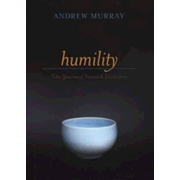
Andrew Murray’s classic Humility: The Journey Toward Holiness unpacks exactly what it looks like to lay down pride and follow Christ’s example of servant-hearted love. It’s a short, convicting read that pairs perfectly with this devotional’s message.
|
Humility: The Journey Toward Holiness (Updated Edition)
By Andrew Murray Genuine love begins with genuine humility. Andrew Murray explains why putting others before ourselves reflects the heart of Christ and strengthens our relationships with fellow believers. Rooted in Scripture, this timeless classic encourages Christians to overcome pride, embrace servant-hearted living, and grow in the kind of love that seeks the good of others before self. |