
The NIV was the first Bible I had because it was the Bible our church used. I started attending that church while working in Hong Kong. Not everyone read from the NIV, and not every preacher used it, but most did, including our senior minister.
I became so familiar with its wording that I could finish a passage once someone started reading. I couldn’t always tell you the chapter and verse, but I knew how it ended.
Later, when I moved to the Middle East and was assigned to the Education Ministry, I began preparing Bible study lessons and preaching every other month. That was when I started consulting other translations, including the NKJV, ESV, and NASB, to help me study Scripture more carefully.
Reading the same passages in different translations made me ask a question I hadn’t thought much about before: Which Bible translation should I actually be reading?
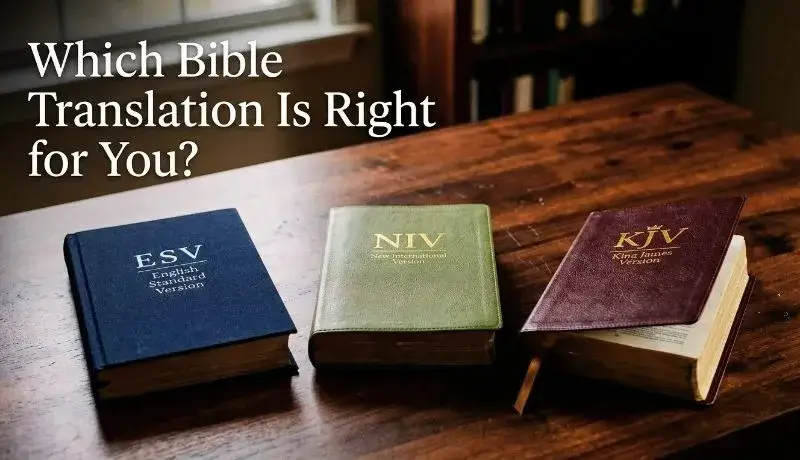
If you’re comparing the ESV, NIV, and KJV, you’re asking a worthwhile question. All three are respected English translations. They just differ in language, approach, and readability.
Let’s look at how, compare the same passages, and see which one might serve you best.
The ESV aims to stay close to the original wording and structure, the NIV balances accuracy with natural English, and the KJV offers the traditional language many readers love. Your best choice depends on your purpose and reading style.
Why Do Bible Translations Differ?
The Old Testament was written mostly in Hebrew, with some portions in Aramaic, while the New Testament was written in Greek. Translating these languages into English involves more than replacing one word with another.
A word in Hebrew or Greek may have several possible meanings, depending on its context. Sentence structures, figures of speech, and expressions also don’t always have direct English equivalents.
Translators must therefore make decisions about how to communicate the meaning of the original text accurately and naturally.

Three factors help explain why translations differ:
- Translation approach. Some translations try to preserve the wording and structure of the original as closely as English allows. Others place greater emphasis on expressing the meaning in natural, contemporary English.
- Language and era. The KJV was published in 1611, when English was different from the English we use today. Modern translations use contemporary language, although they vary in style.
- Intended use. Some translations are especially useful for close study, while others are easier to follow during extended reading or when listening to Scripture read aloud.
These differences don’t automatically make one translation faithful and another unfaithful. Every translation involves decisions. The important thing is to understand those decisions and recognize how they can affect the way we read a passage.
Which Bible Translation Is Most Accurate? Word-for-Word vs. Thought-for-Thought
You may have heard Bible translations described as either word-for-word or thought-for-thought. These terms are useful, but they describe a spectrum rather than two completely separate categories.
Formal equivalence, commonly called word-for-word translation, seeks to preserve the original wording and sentence structure as closely as possible while remaining understandable in English.
Functional or dynamic equivalence, often called thought-for-thought translation, places greater emphasis on communicating the meaning in natural English.
Here’s how the three translations generally approach this balance:
- KJV: Follows the wording and structure of its source texts relatively closely, using the English of its time.
- ESV: Describes its approach as “essentially literal,” emphasizing close correspondence to the original wording and structure.
- NIV: Seeks to balance accuracy with readability, expressing the meaning of the original text in clear, natural English.
Think of these as general tendencies, not rigid categories. Even a more literal translation must make interpretive decisions, while a more readable translation still aims to communicate the original text faithfully.
In practical terms, a translation that stays closer to the original structure can help you notice repeated words and expressions. A translation that uses more natural English can make a passage easier to understand on the first reading. Both approaches have value, and neither removes the need to consider context.
KJV Bible Translation: Strengths, Limitations, and Who It’s For
The King James Version was published in 1611, and its distinctive rhythm has shaped how generations of English-speaking Christians read and remember Scripture.
Many familiar biblical phrases come from the KJV. Its cadence also makes it appealing to readers who appreciate traditional language, especially in public worship and memorization. Reading it can help you engage with older sermons, hymns, and devotional writings that frequently quote it.
However, the KJV’s language can be challenging for modern readers.
Some words have changed meaning over time. When Jesus says, “Suffer the little children to come unto me,” for example, suffer means allow. In 1 Thessalonians 4:15, prevent means precede. Without knowing these older meanings, a reader may misunderstand what a passage is saying.
The pronouns thee and thou can also be unfamiliar. They distinguish singular forms of “you” in ways that modern English generally does not. Once you understand them, they can be helpful, but they may slow down someone encountering the language for the first time.
There is another difference worth understanding: the textual resources available to the KJV translators.
The KJV translators worked with the Hebrew and Greek texts and other translation resources available to them in the early seventeenth century. Since then, additional ancient biblical manuscripts have been discovered, and textual scholarship has continued to develop. Modern translations draw on a broader body of manuscript evidence.
As a result, readers may encounter verses or phrases in the KJV that are absent from the main text of a modern translation, appear in a footnote, or are worded differently. Such differences need to be examined passage by passage. They do not, by themselves, establish that the KJV is untrustworthy or that modern translations are corrupt.
The KJV may be a good fit if you appreciate traditional English, are familiar with its vocabulary, or want to engage with the language used in many older Christian resources. If you’re new to Bible reading, take time to learn its older expressions so you can understand the text as it was intended.
ESV Bible Translation: Strengths, Limitations, and Best Uses
The English Standard Version was published in 2001 and belongs to the translation tradition of the Revised Standard Version.
One of the ESV’s strengths is its emphasis on preserving the wording and structure of the original languages where English allows. It often seeks consistent wording for important recurring terms when the context permits. This can help you trace themes and connections across a passage or throughout a biblical book.
That approach is one reason many readers appreciate the ESV for close study. When you’re comparing related passages or following a repeated expression, its relatively formal style can make those connections easier to notice.
But that same style can sometimes feel stiff.

Paul’s letters, for example, contain long and complex arguments. The ESV often preserves much of that structure, which can make certain sentences harder to follow on the first reading. In Romans 12:2, the phrase “that by testing you may discern” is precise but may sound formal to some readers.
This doesn’t mean the ESV is difficult for everyone. If you enjoy slowing down, examining individual words, and tracing how an argument develops, you may find its style helpful. If you prefer to read several chapters at a time without stopping often, some passages may require more concentration.
When I study a passage, I appreciate being able to compare its wording with other translations. The ESV gives me one way of looking closely at the text, while another translation can help me see how the same thought is expressed in more natural English.
The ESV may be a good fit if you want a translation for close study, enjoy examining recurring words and phrases, or prefer a relatively formal modern style. A study Bible with helpful notes and cross-references can also support your study, regardless of which translation you choose.
NIV Bible Translation: Readability, Strengths, and Limitations
The New International Version was first published as a complete Bible in 1978, with later revisions in 1984 and 2011. It was produced by an international team of biblical scholars from various church backgrounds.
The NIV uses contemporary vocabulary and natural English sentence structures. This often makes it easier to follow during extended reading, particularly if you’re new to the Bible or prefer not to stop frequently to work through unfamiliar wording.
That readability is one of its strengths. It helps readers follow the flow of a story, the point of an argument, or the message of a passage without becoming distracted by older expressions.
However, clear wording sometimes requires translators to choose how best to express a phrase that allows more than one interpretation. A translation may communicate the intended sense naturally while making an interpretive decision less visible to the reader.
This is why footnotes matter. They can show alternative readings or explain differences that aren’t immediately apparent in the main text. When a passage raises a question, checking the footnotes or comparing another translation can help you examine it more carefully.
The 2011 NIV also uses gender-inclusive wording in some contexts where the original language refers to people generally. Readers differ in how they evaluate these choices. If this is important to you, compare relevant passages and consider the translators’ explanations before choosing an edition.
The NIV may be a good fit if you want accessible modern English for daily reading, are beginning your Bible study journey, or often read Scripture aloud to people with different levels of familiarity with the Bible.
ESV vs NIV vs KJV: Comparing Three Bible Passages
Reading descriptions of translation approaches is helpful, but comparing actual passages can make the differences easier to understand.
As you read the examples below, notice which words remain the same, which expressions differ, and how those choices affect your understanding. Remember that a difference in wording doesn’t automatically mean a difference in biblical teaching.
Psalm 23:1–2
KJV: “The LORD is my shepherd; I shall not want. He maketh me to lie down in green pastures: he leadeth me beside the still waters.”
ESV: “The LORD is my shepherd; I shall not want. He makes me lie down in green pastures. He leads me beside still waters.”
NIV: “The LORD is my shepherd, I lack nothing. He makes me lie down in green pastures, he leads me beside quiet waters.”
Notice “I shall not want.” In older English, want means lack. Today many readers hear desire. The NIV’s “I lack nothing” says it in modern words. The KJV and ESV keep the wording many readers know by heart.
The difference gives us a practical lesson: a familiar phrase may be meaningful to someone who has heard it for years, while another reader may need clearer modern wording to understand it.
John 3:16
KJV: “For God so loved the world, that he gave his only begotten Son, that whosoever believeth in him should not perish, but have everlasting life.”
ESV: “For God so loved the world, that he gave his only Son, that whoever believes in him should not perish but have eternal life.”
NIV: “For God so loved the world that he gave his one and only Son, that whoever believes in him shall not perish but have eternal life.”
The Son is described three ways: “only begotten” (KJV), “only” (ESV), and “one and only” (NIV). They reflect different ways of rendering the Greek word monogenēs, which scholars continue to discuss. The older “whosoever” and “believeth” simply say what “whoever” and “believes” say today. A longer or shorter phrase doesn’t add or remove a doctrine. Check the context and a reliable study resource.
Romans 12:2
KJV: “And be not conformed to this world: but be ye transformed by the renewing of your mind.”
ESV: “Do not be conformed to this world, but be transformed by the renewal of your mind.”
NIV: “Do not conform to the pattern of this world, but be transformed by the renewing of your mind.”
The NIV says “the pattern of this world.” The KJV and ESV say “this world.” The NIV makes the idea more explicit while the others leave you to work out the sense from context. Either way, read the surrounding verses and Paul’s wider teaching.
Which Bible Translation Is Best for You? ESV vs NIV vs KJV
There isn’t one translation that is best for every reader and every situation. Your purpose, familiarity with the language, and preferred reading style all matter.
Here are some practical starting points.
If You’re New to Bible Reading
The NIV is a reasonable place to start because its contemporary English is generally easy to follow. The ESV may also work well if you prefer a more formal style. You don’t need to understand every detail immediately. Begin reading, ask questions, and grow in understanding as you go.
If You Want to Study Scripture Closely
Consider the ESV, particularly if you want to observe recurring words and follow the structure of a passage. You can consult the NIV or another translation when a sentence is difficult to understand. Study notes and cross-references can also help, provided you check explanations against Scripture itself.
If you’re considering the ESV for in-depth Bible study, you may also want to read my ESV Study Bible review. I look at its study notes, maps, theological articles, and other features to help you decide whether this resource would be useful for your own study.
If You Want to Memorize Verses
Consider using the translation you hear most often in church or the one whose wording you find easiest to remember. Memorization becomes more consistent when you use the same wording regularly. The KJV’s rhythm appeals to many readers, but familiarity and personal preference matter more than any universal rule.
If You Regularly Read Scripture Aloud
Think about the people listening. A congregation familiar with the KJV may appreciate its traditional sound, while a group that includes new readers may follow the NIV more easily. The ESV can also work well, although some of its longer sentences may require careful delivery.
And if none of these three feels right for you, the NLT, NASB, and CSB are also worth considering. You don’t have to choose a translation simply because someone else prefers it.
The goal is to find a reliable translation you can understand, read consistently, and use to grow in your knowledge of God’s Word.
Recommended Resource: ESV Large Print Value Thinline Bible
If you’ve chosen the ESV for your everyday Bible reading, this large-print edition is worth considering. Its thinline format makes it convenient to carry, while the larger print offers a more comfortable reading experience. The Quiet Forest TruTone cover also gives it a lovely, understated design.
Affiliate Disclosure: This post contains affiliate links. As an Amazon Associate, I earn from qualifying purchases at no additional cost to you.
How to Choose a Bible Translation Before You Buy

Before spending money on a new Bible, try reading the translations you’re considering. Many Bible websites and apps let you compare versions side by side for free.
Here is a simple way to do that:
1️⃣ Choose two different kinds of passages.
Read a narrative from one of the Gospels and an argumentative passage from a letter, such as Romans. Different types of writing can reveal different strengths and challenges.
2️⃣ Read each passage aloud.
Notice which wording you can follow naturally and where you have to stop to think about a phrase.
3️⃣ Compare the differences.
When a verse sounds different, ask why. Check the footnotes and surrounding context rather than assuming that one translation must be wrong.
4️⃣ Consider the physical edition.
If you’re buying a printed Bible, check the font size, page layout, paragraph style, footnotes, and available margin space. A Bible that’s comfortable to read and use is more likely to become part of your daily routine.
You may also benefit from keeping a second translation nearby. When a verse seems unclear, comparing another version can reveal a different way of expressing the same passage. It may also help you identify a question that needs closer study.
If you’d like to learn how to examine Scripture more carefully, my guide on [how to use a Bible commentary the right way] can help you understand how commentaries support Bible study without replacing the biblical text.
The KJV, ESV, and NIV each have strengths and limitations. Compare them thoughtfully, consider your needs, and choose a reliable translation you will read consistently.
Frequently Asked Questions
What is the main difference between ESV and NIV?
The biggest practical difference is how they balance the original wording with natural English expression. The ESV generally follows a more formally equivalent approach, while the NIV places greater emphasis on communicating meaning in accessible modern English. Comparing a passage in both can help you see the benefits of each approach.
Which translation is most accurate: ESV, NIV, or KJV?
Accuracy can’t be measured by one rule, such as how closely a translation follows the original sentence structure. All three are faithful translations with different approaches. Compare their wording, footnotes, and treatment of specific passages instead of assuming one is always better.
Is the KJV the only trustworthy Bible?
No. The KJV is an influential and respected English translation, but it is not the only faithful translation available. Modern translations draw on extensive manuscript evidence and scholarship. If you encounter a difference between the KJV and another version, examine the specific passage and its textual notes before drawing conclusions.
Is the NIV too simple for serious Bible study?
No. Readability doesn’t make a translation unsuitable for serious study. The NIV is used by many readers who study Scripture carefully. As with any translation, it helps to consider context, check footnotes, and compare other versions when a passage raises questions.
Can I read more than one Bible translation?
Yes. Many readers use one translation for regular reading and consult another when they want to examine a passage more closely. Comparing translations can help you notice differences in wording and identify questions worth investigating. Just remember that comparing versions is a tool for understanding Scripture, not a substitute for reading passages in context.
Which translation is easiest for a beginner?
Many beginners find the NIV accessible because it uses contemporary English. The ESV may suit readers who prefer a more formal style, while the KJV often requires more adjustment because of its older vocabulary and grammar. The best way to decide is to read a few passages in each and see which one you understand most comfortably.
Which Bible Translation Do I Use? My Personal Choice

I started with the NIV, and I still love it. Today, I mostly use the ESV for my personal study and for the articles I write here. I appreciate how it often preserves recurring words and the structure of a passage, which helps me trace themes and connections as I study.
But I still reach for the NKJV and NIV from time to time, especially when preparing Bible study lessons and sermons for our local church. Reading the same passage in another translation sometimes helps me notice something I hadn’t considered before.
That’s what works for me. It isn’t a rule everyone has to follow.
What matters most is that we read God’s Word carefully, consider the context, and allow Scripture to shape our understanding. A translation is a tool that helps us do that, and comparing translations can be useful when we approach them thoughtfully.
If you’re still deciding, pick one this week and read a chapter aloud. If the wording is difficult to follow, try another translation and compare the two.
When you’re ready to take the next step, explore my Bible study for beginners guide or learn how to study the Bible verse by verse.
Which Bible translation do you read, and why? I’d love to hear about your experience in the comments.