

I still remember sitting with a decision that felt almost impossible to make. I had spent more than 11 years working at the same healthcare facility abroad. Over a decade of relationships, routines, responsibilities, and a life built around that place.
Then I had a choice to make. Should I go home to the Philippines for good, or transfer to another company and commit to another two-year contract?
I prayed about it. I talked it through with people I trusted. I made lists and considered what each option would cost and what it would mean for my family. But there was no audible voice from heaven telling me which option to choose.
What I needed was not a louder sign. I needed a clearer way to think through the decision, one grounded in something more dependable than my emotions or circumstances.
Perhaps you have been there too.
Maybe you are trying to decide whether to take a new job, make a major purchase, move to another place, confront a difficult situation, or make a decision that will affect your family.
How do you know what to do when the Bible does not give you a verse that says, “Take this job,” or “Move to this house,” or “Choose this particular option”?
This is where biblical wisdom becomes important.
Biblical decision making is not a formula that guarantees we will always make the perfect choice. It is a way of learning to think and live under the authority of God’s Word.
How Do I Know What God Wants Me to Do?
Many Christians ask, “How do I know what God wants me to do?”
Applying biblical principles does not mean hunting for a verse that seems to match every decision in front of us. Scripture was not written as a detailed instruction manual telling us which car to buy, which career to choose, which house to live in, or which particular option to select in every situation.
Instead, God’s Word shapes our hearts and minds so that we increasingly learn to recognize what is pleasing to Him. Romans 12:2 connects spiritual transformation with learning to discern God’s will, while Philippians 1:9-10 connects growing in love with knowledge and discernment.
Sometimes the answer is clear because Scripture gives us a direct command. In those situations, we do not need to pray for permission to disobey what God has already revealed.
But many everyday decisions fall into areas where Scripture gives us principles rather than one specific answer. That changes the question.
Instead of asking only, “Which option does God want me to choose?” we can also ask:
“How can I make this decision in a way that honors God?”
That is where biblical wisdom and discernment come in.
We can pray for wisdom (James 1:5), seek godly counsel, and think carefully about the likely consequences of our choices.
Biblical decision making, then, is not about discovering a hidden verse or waiting for a mysterious sign. It is about trusting God, obeying what He has already revealed, and faithfully applying biblical principles to the circumstances in front of us.
A wise decision does not necessarily mean an easy decision. Following God faithfully does not guarantee that every choice will produce the outcome we hoped for. But we can trust God’s character even when we cannot see everything that lies ahead.
Proverbs 3:5-6 reminds us to trust in the Lord rather than leaning entirely on our own understanding. That does not mean we stop thinking. It means we stop treating our own understanding as our highest authority.
Biblical Principles That Should Shape Our Decisions
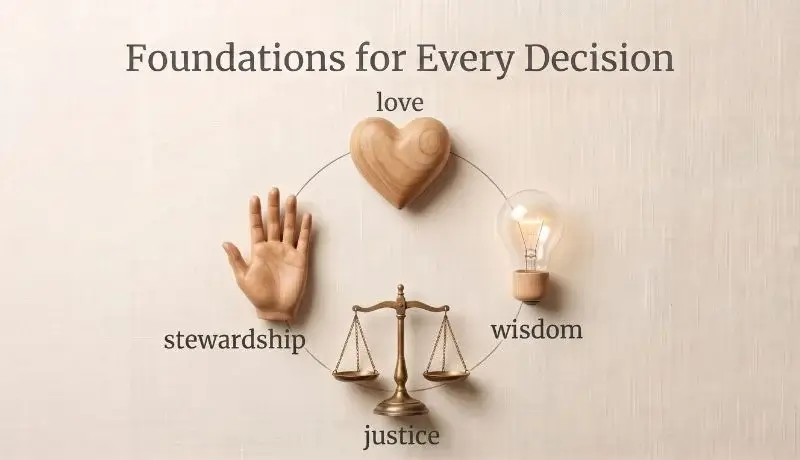
Before considering a particular decision-making process, it helps to understand the principles that should guide us.
Love
Jesus identified love for God and love for our neighbor as the greatest commandments (Matthew 22:37-40). That means our decisions should not be driven solely by personal preference.
We should consider how our choices affect God, the people around us, and the responsibilities He has entrusted to us.
Wisdom
James 1:5 tells us to ask God for wisdom. Wisdom is more than knowing facts. It involves learning to apply what is true to the circumstances in front of us.
That is why biblical decision making involves both Scripture and careful thinking.
Truth and Integrity
God calls His people to speak truth and live honestly (Ephesians 4:25). This matters when we are making decisions about work, money, relationships, contracts, business, and countless other areas of life.
If an option requires dishonesty or compromise, we do not need to wonder whether it is God’s will.
Justice and Humility
Micah 6:8 points us toward justice, mercy, and humility. These principles can help expose selfish motives that might otherwise disguise themselves as wisdom.
We should ask not only, “What benefits me?” but also, “Is this fair? Am I treating others rightly? Am I walking humbly before God?”
Stewardship
Everything we have ultimately belongs to God (Psalm 24:1).
Our time, money, abilities, opportunities, relationships, and influence are entrusted to us. First Corinthians 4:2 reminds us that those who are entrusted with something must be found faithful. That means stewardship should influence our decisions.
A financially possible decision may not necessarily be a wise financial decision. A career opportunity may offer more money but demand something that would seriously affect our responsibilities. A convenient choice may not always be the most responsible one.
Discernment
Discernment helps us apply biblical truth to situations Scripture does not address by name.
The Bible does not tell us which phone to buy, which software to use, which job offer to accept, or which investment to make. But Scripture gives us principles that help shape how we approach those decisions.
And we need to remember one important thing: Scripture must be read in context.
It is easy to find an isolated verse that seems to support what we already want to do.
Biblical discernment does the opposite. It allows the whole counsel of God’s Word to challenge our assumptions, correct our desires, and shape our thinking.
A Six-Step Biblical Decision-Making Framework
So how do we actually put these principles into practice?
Here is a simple framework you can use for both ordinary decisions and major crossroads.
1️⃣ Name the Decision Clearly
Sometimes we feel overwhelmed because we are carrying a vague problem instead of a clearly defined decision.
Write it down.
What exactly are you deciding?
What options are actually available?
What responsibilities are involved?
Who will be affected?
What fears, desires, assumptions, or pressures are influencing you?
Naming the decision clearly can bring order to a situation that feels confusing. It also helps separate the actual decision from the emotions surrounding it.
2️⃣ Test It Against Scripture
Once you have clearly identified the decision, ask what Scripture says about it.
Does either option violate a clear biblical command? Would one choice require dishonesty, injustice, sexual immorality, greed, unforgiveness, or some other form of disobedience?
If Scripture clearly prohibits something, we do not need to ask God to give us peace about doing it. But perhaps neither option violates Scripture.
That is where biblical principles become especially important. Consider love, truth, wisdom, stewardship, justice, humility, faithfulness, self-control, and your existing responsibilities.
The question is not simply, “Can I do this?”
Ask instead, “Can I do this faithfully before God?”
3️⃣ Pray for Wisdom and Examine Your Motives
Prayer should not be a religious way of asking God to approve a decision we have already made.
Ask God to search your heart.
Are you motivated by fear? Greed? Pride? People-pleasing? Comparison? Impatience?
Or are you genuinely seeking to honor Him?
Psalm 139:23-24 gives us a helpful picture of inviting God to search and examine us. James 1:5 reminds us to ask God for wisdom.
Prayer does not replace thinking. It brings our thinking under God’s authority.
4️⃣ Gather the Facts
Faith does not mean refusing to do research.
Scripture repeatedly commends wisdom, prudence, and careful consideration. Proverbs 18:13 warns against answering a matter before hearing it fully.
If you are considering a job, research the company.
If you are making a major purchase, understand the cost.
If you are considering a financial commitment, look carefully at the numbers.
If a decision involves medical, legal, or professional matters, seek reliable information from qualified people.
Trusting God does not mean turning off your brain. Wise faith and careful preparation belong together.
5️⃣ Seek Wise Counsel
We were never designed to make every decision alone.
Proverbs 15:22 and Proverbs 11:14 both emphasize the value of wise counsel.
Talk to people who are trustworthy, spiritually mature, and willing to tell you the truth rather than simply telling you what you want to hear. Sometimes the person who loves us most is the one who asks the uncomfortable question we have been avoiding.
At the same time, seeking counsel does not mean surrendering personal responsibility. Other people can offer wisdom. They cannot make your decision for you.
Bring their counsel back to Scripture, prayer, and careful consideration.
6️⃣ Choose, Act, and Review
Eventually, you have to make the decision.
There comes a point when endlessly analyzing every possibility stops being wisdom and becomes paralysis.
If you have prayed, examined the decision through Scripture, gathered the facts, considered your motives, and sought wise counsel, you can move forward with humility.
You may still feel uncertain. That does not automatically mean you have missed God’s will. Make the best decision you can with the wisdom and information you have, then entrust the outcome to God.
Afterward, take time to reflect.
What did you learn?
What would you do differently?
Did the experience expose a weakness in your thinking or a motive you had not recognized?
Decision making can become part of our spiritual growth when we allow experience to teach us.
So, the rhythm is simple:
Name it. Test it. Pray about it. Research it. Seek counsel. Decide and learn.
How to Apply Biblical Decision Making to Everyday Life
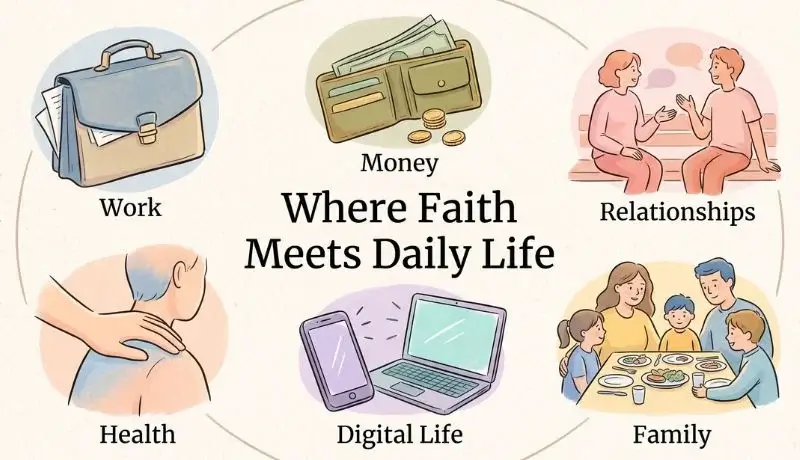
Biblical principles become especially meaningful when they meet the ordinary decisions of everyday life.
Work and Career
A job decision involves more than salary.
Consider your responsibilities, opportunities to serve, work environment, integrity, family commitments, rest, and the ways the position may affect the people entrusted to your care.
More money is not automatically a better decision. Neither is a lower-paying position automatically more spiritual.
Colossians 3:23-24 reminds us to work wholeheartedly, as for the Lord and not merely for people. That can help us weigh an opportunity by more than the paycheck.
Ask how the opportunity fits with your responsibilities, gifts, values, and commitment to honor God.
Money and Major Purchases
Financial decisions give us plenty of opportunities to examine our hearts.
Am I acting from genuine need or from comparison?
Can I afford this responsibly?
Will this create unnecessary debt?
Does this decision allow room for generosity and faithful stewardship?
Contentment is important here too. Hebrews 13:5 calls us to keep our lives free from the love of money and to be content with what we have.
Not every desire needs to become a purchase.
Relationships and Conflict
Relationships require wisdom, truth, forgiveness, humility, and love.
Ephesians 4:15 speaks of speaking the truth in love, while Romans 12:18 calls believers to pursue peace where possible. But pursuing peace does not mean tolerating abuse or pretending that serious wrongdoing does not matter.
Sometimes biblical wisdom includes establishing appropriate boundaries and seeking outside help.
Family and Parenting
Family decisions often involve competing responsibilities.
Parents may need to balance discipline with compassion, provision with presence, and protection with allowing children to grow.
There may not always be one obvious answer. Ask what faithfulness, love, wisdom, and responsibility look like in the particular situation you are facing.
Technology and Entertainment
The Bible does not give us a list of approved apps, streaming services, websites, or social media platforms. But it does give us principles concerning what we allow to influence our minds, how we use our time, how we speak, and what kind of people we are becoming.
Philippians 4:8 encourages us to fill our minds with what is true, honorable, pure, and worthy of praise.
Ask: What is this habit producing in me?
Is it helping me grow, or is it gradually shaping me in ways that pull me away from Christ?
Health and Difficult Circumstances
Some decisions are especially difficult because the stakes are high.
Health concerns, caregiving responsibilities, financial crises, legal problems, addiction, abuse, and severe emotional distress may require more than personal reflection.
Pray.
Read God’s Word.
But also seek qualified help.
Doctors, counselors, financial professionals, legal professionals, pastors, and other appropriate experts can provide knowledge that we may not possess.
Seeking qualified help is not a failure to trust God. God can use people and ordinary means as part of His provision and wisdom.
Common Mistakes Christians Make When Making Decisions
Even sincere Christians can fall into unhealthy patterns of discernment.
Treating Feelings as Infallible
Our feelings matter, but they are not infallible.
Feeling anxious does not necessarily mean a decision is wrong. Feeling peaceful does not necessarily mean a decision is right.
Our emotions should be acknowledged, but they should not become our final authority.
Waiting for a Sign
Sometimes Christians become so afraid of making the wrong choice that they refuse to move until God gives them an unmistakable sign.
But Scripture does not teach us to demand supernatural confirmation for every ordinary decision.
Some may point to Gideon’s fleece in Judges 6:36-40. God did answer Gideon patiently. But Gideon had already received a clear word from the Lord (Judges 6:14-16). The account describes a moment of doubt. It does not set a pattern for how we should make decisions.
God has already given us His Word. We can move forward faithfully without requiring a dramatic sign.
Cherry-Picking Scripture
This is one of the easiest traps to fall into. We decide what we want to do and then search for a verse that seems to support it.
That is not letting Scripture shape our decisions. That is using Scripture to justify a decision we have already made.
Instead, approach God’s Word with humility and allow it to correct you when necessary.
Assuming There Is Only One Acceptable Choice
Some decisions really do have a clear biblical answer. Others do not.
If Scripture gives a direct command, obedience matters. But when Scripture gives principles rather than one specific answer, faithful Christians may prayerfully reach different conclusions.
Romans 14 provides an important biblical framework for handling matters of conscience and Christian liberty.
We need both conviction and charity.
Confusing an Open Door with God’s Approval
Circumstances can be helpful, but an open door is not automatically God’s endorsement.
Something may be possible and still be unwise.
Something may be difficult and still be right.
Circumstances should be considered alongside Scripture, wisdom, prayer, counsel, and the responsibilities God has already given us.
Make Biblical Discernment a Way of Life

Biblical decision making is not a technique we use only when facing a major crossroads. It is a way of living.
Regular Scripture reading teaches us God’s character and priorities. Prayer keeps us dependent on Him. Christian community gives us opportunities to receive correction and wise counsel. Confession keeps our hearts humble. Reflection helps us learn from experience.
You can even develop a simple daily checklist:
Is it truthful?
Is it loving?
Is it wise?
Is it just?
Is it responsible?
Is it consistent with my commitments?
Can I do this with a clear conscience before God?
Practice these questions with small decisions. Discernment develops over time.
And when you get it wrong, remember that making a poor decision does not mean your relationship with God is over.
There is grace for our mistakes.
When we sin, we repent.
When we hurt someone, we seek to make things right.
When we make an unwise choice, we learn.
Spiritual maturity does not mean becoming someone who never makes mistakes. It means becoming someone increasingly willing to submit every area of life to God.
You Don’t Have to Figure It All Out Alone
I think back to that season after more than 11 years abroad.
The decision to return home was not simply an employment decision. It involved my family, my future, my responsibilities, and what faithfulness looked like in that particular season of my life.
There was no dramatic sign that settled everything for me.
Instead, I prayed. I considered the facts. I listened to people I trusted. I examined my motives. And eventually, I had to make a choice.
Looking back, I am reminded that God does not always give us a detailed map showing every step ahead. Sometimes He gives us something better for the journey: His Word, His wisdom, His people, and the assurance that He remains faithful.
Psalm 119:105 calls His Word a lamp to our feet. It lights the next step, not the whole road.
So, if you are facing a decision, slow down. Pick one decision and walk through the six steps this week. Then talk it over with a mature believer you trust.
You do not need to know everything that will happen tomorrow to faithfully obey God today.
Our goal is not to become people who can predict every outcome.
Our goal is to become people who know God, trust His Word, seek His wisdom, and faithfully walk with Him in whatever decisions are placed before us.
And sometimes, that is what biblical discernment looks like. Not certainty about the future.
Faithfulness in the present.
Frequently Asked Questions
How do I know if a decision is biblical?
Start by asking whether Scripture directly addresses the matter. If God has clearly commanded or forbidden something, we should obey rather than search for reasons to justify the opposite choice.
If Scripture does not give a direct command, look at the broader biblical principles that apply. Pray for wisdom, examine your motives, gather the relevant facts, and seek godly counsel. God can also use circumstances and opportunities, but they should always be tested against His Word.
What if I don’t feel peace about either option?
Lack of peace does not automatically mean that both options are wrong. Feelings can alert us to something that needs attention, but they should not become our final authority.
Continue praying, gathering facts, examining your motives, and seeking wise counsel. Sometimes clarity comes through the process rather than before it.
Is it wrong to research and plan instead of simply trusting God?
No. Trusting God does not mean refusing to gather information or think through consequences.
Proverbs repeatedly commends wisdom and careful counsel. Prayer and preparation are not opposites. We can prayerfully seek God while also doing the practical work necessary to make a responsible decision.
What if mature Christians disagree with my decision?
Listen carefully. Do not dismiss wise counsel simply because it challenges you. At the same time, remember that you remain personally responsible before God.
Where Scripture gives a clear command, God’s Word settles the matter. Where Scripture gives principles rather than one required answer, faithful believers may sometimes reach different conclusions.
When should I seek professional help?
Seek qualified help when a decision involves matters beyond your knowledge or when someone’s safety or well-being is at risk. This may include abuse, danger, addiction, severe emotional distress, significant financial problems, legal matters, or serious health concerns.
Seeking appropriate professional help is not a lack of faith. It can be part of wise stewardship and responsible decision making.
Final Takeaway
Biblical decision making is not about finding a secret answer hidden somewhere in Scripture. It is about learning to think biblically, seek God’s wisdom, examine our motives, listen to wise counsel, and make faithful choices under the authority of His Word.
We may not always know what tomorrow will bring. But we can seek to honor God with the decision in front of us today.
This post contains affiliate links, which means I may earn a commission at no extra cost to you if you make a purchase through one of these links. I only recommend products or services I trust and personally use. Thank you for supporting Biblical Christianity!
Recommended Resource
Want to go deeper? If you’re looking for practical help in moving from simply reading Scripture to actually living it out, How Do I Live the Bible? by Dr. Barry Knowles is a helpful resource to explore. It offers practical guidance for applying biblical truth to everyday decisions, relationships, spiritual growth, and the ordinary challenges of life.
How Do I Live the Bible?
By Dr. Barry Knowles
Knowing what the Bible says is one thing; learning how to live it out every day is another. This practical guide helps Christians apply Scripture to everyday decisions, relationships, spiritual growth, rest, generosity, hospitality, and other areas of daily life.
With an emphasis on practical, Scripture-shaped living, this book offers accessible guidance for moving from simply reading the Bible to putting God’s Word into practice.