

January has a way of making us think about plans.
Even when we don’t believe in New Year’s resolutions, there’s still a quiet pressure in the air: to figure things out, to make decisions, to know where we’re headed next.
We pray. We ask God for direction. We say we trust Him. And yet, deep down, many of us are still holding our plans very tightly.
I’ve learned that trusting God isn’t always the hardest part. Sometimes, letting go is.
We can believe God is good and faithful while still struggling to release control. We can surrender in words but hesitate in practice. And often, what causes anxiety at the start of a new year isn’t a lack of faith. It’s the fear of placing our plans fully in God’s hands.
“The heart of man plans his way, but the Lord establishes his steps.” — Proverbs 16:9
This year, instead of asking, “What should I do next?” Maybe the better question is, “What am I holding onto that God is asking me to release?”
Why Letting Go of Our Plans Feels So Difficult

Plans give us a sense of safety.
They help us feel prepared, responsible, and in control. When life feels uncertain, having a plan makes us feel grounded, even spiritual. After all, planning isn’t wrong. Scripture encourages wisdom and diligence.
So why does letting go feel so uncomfortable? Because plans often become more than plans. They become:
- Our sense of security
- Our timeline for fulfillment
- Our backup plan in case God doesn’t act the way we expect
Letting go feels risky. It raises questions we don’t like answering:
- What if I waste time?
- What if I miss my opportunity?
- What if God leads me somewhere I didn’t want to go?
At its core, this struggle isn’t really about trust; it’s about control.
“Trust in the Lord with all your heart, and do not lean on your own understanding.” — Proverbs 3:5–6
Many believers ask, “How do I let go of my plans and trust God?” The honest answer is this: letting go often means facing the fear of the unknown instead of avoiding it.
Trusting God vs. Surrendering Your Plans
This distinction matters. You can trust God and still resist surrender.
Trusting God means:
- Believing He is faithful
- Believing His Word is true
- Believing He knows what is best
But surrendering your plans means:
- Releasing your timeline
- Submitting your expectations
- Accepting outcomes you cannot control
Trust says, “God, I believe You can.” Surrender says, “God, I accept whatever You choose.” Jesus made this clear when He said:
“If anyone would come after Me, let him deny himself and take up his cross daily and follow Me.” — Luke 9:23
Surrender is not a one-time decision. It is a daily posture of obedience.
What Biblical Surrender Actually Looks Like
One of the clearest pictures of surrender in Scripture is Jesus in the Garden of Gethsemane. Jesus prayed honestly. He didn’t pretend the path ahead was easy.
“Father, if You are willing, remove this cup from Me. Nevertheless, not My will, but Yours, be done.” — Luke 22:42
Notice what surrender looks like here:
- Honest desire
- Emotional struggle
- Complete submission
Biblical surrender does not erase desire. It submits it. Surrender is not indifference. It is obedience, even when the cost is real.
When God Asks You to Let Go Without Explaining What’s Next

This is often where surrender becomes most difficult: when God asks us to trust Him without giving us certainty about what lies ahead.
I experienced this deeply when I decided to leave my job in the Middle East after more than eleven years. It wasn’t a sudden or careless choice. That work had provided stability and security for a long time. Yet God placed a clear conviction on my heart to come home: to be with my family and to serve more fully in church ministry.
What made the decision harder was the uncertainty that followed.
At that time, my husband was working for his sister and earning a modest income. Financially, nothing felt guaranteed. I didn’t have a clear plan for what would come next, and I didn’t know how things would unfold. What I did have was a quiet confidence that God was leading, even though the path ahead wasn’t clear.
Choosing to come home meant letting go of financial security, professional identity, and the comfort of knowing what the future might look like. It meant trusting God without explanations, timelines, or visible safety nets.
More than two years later, in a season when I still didn’t have everything figured out, God gently led me back to this very website—one I had previously neglected. What once felt like a closed chapter became part of His unfolding purpose, revealed in His time, not mine.
Scripture reminds us that this kind of faith has always been part of God’s story.
“By faith Abraham obeyed when he was called to go out to a place that he was to receive as an inheritance. And he went out, not knowing where he was going.” — Hebrews 11:8
Like Abraham, we are often given only the next step, not the full map. And while surrender without certainty can feel unsettling, it is often where our faith grows deepest.
If you’re asking, “Can I really trust God with my future?” or “How can I trust God with my future plans when nothing feels secure?”—you’re not alone. God’s faithfulness is often revealed after obedience, not before.
Practical Ways to Let Go and Trust God With Your Plans This Year
Letting go doesn’t happen overnight. It happens through intentional, daily choices. Here are practical, grace-filled ways to begin:
1️⃣ Pray open-handed prayers
Instead of asking God to bless the plans you’ve already made, invite Him to interrupt, redirect, or reshape them.
Open-handed prayers sound like, “Lord, this is what I desire, but I trust You more than my desires.” They create space for God to work without resistance and remind your heart that He is Lord, not just a helper.
2️⃣ Hold goals loosely, not tightly
Goals can be helpful guides, but they should never become fixed demands we place on God.
When a goal becomes an identity or a measure of success, it’s often a sign we’re clinging too tightly. Holding goals loosely means being willing to adjust, or even release them, when God leads in a different direction.
3️⃣ Obey what God has already revealed
Many times, we delay obedience while waiting for more clarity, confirmation, or reassurance.
Yet God often speaks through what He has already made clear: His Word, convictions in prayer, and opportunities right in front of us. Obedience in small, known steps builds trust for the unknown ones ahead.
4️⃣ Release timelines and expectations
Timelines can quietly become sources of pressure, comparison, and disappointment. Releasing them doesn’t mean giving up hope; it means trusting that God’s timing is wiser than our urgency.
When we stop insisting on when things should happen, we free our hearts to rest in God’s sovereignty.
5️⃣ Practice surrender daily, not just once
Surrender is not a one-time decision you make at the start of the year. Rather, it’s a daily posture of the heart. Each day brings new opportunities to either reclaim control or entrust your plans to God again. Choosing surrender daily trains your heart to depend on God rather than your own understanding.
“Commit your way to the Lord; trust in Him, and He will act.” — Psalm 37:5
Finding Peace by Letting Go (Even When Nothing Changes Yet)
Peace doesn’t always come from changed circumstances. Often, it comes from realignment.
When we stop fighting for control and start resting in God’s authority, something shifts within us, even if life around us stays the same.
“Do not be anxious about anything… and the peace of God, which surpasses all understanding, will guard your hearts and your minds in Christ Jesus.” — Philippians 4:6–7
Finding peace by letting go doesn’t mean everything makes sense. It means your heart is no longer striving for control.
A Prayer for Surrendering Your Plans to God

Father God,
I come before You with plans I’ve held tightly and expectations I’ve quietly guarded. I confess that sometimes I trust You with my words, but not fully with my heart.
Teach me how to let go and trust You completely. Help me surrender my plans, my timelines, and my need for certainty. Give me the courage to obey even when I don’t see the full path.
I place my future in Your hands. Lead me, establish my steps, and teach me to rest in Your will.
Amen.
Key Takeaway
Letting go is not a loss; it is an act of faith. When you surrender your plans to God, you are not giving up direction. You are choosing trust over control and obedience over certainty.
Frequently Asked Questions
1️⃣ How do I let go and trust God when I feel anxious?
Start with prayer and honesty. Acknowledge your fear before God and ask Him to help you release control one step at a time.
2️⃣ Can I still make plans as a Christian?
Yes. Planning is biblical, but plans must remain submitted to God’s will and timing.
3️⃣ What if I surrender my plans and nothing changes?
Surrender doesn’t always change circumstances immediately. Often, it changes your heart first.
4️⃣ How can I trust God with my future plans?
By choosing obedience over clarity and faith over control. Trust grows as you walk forward with God daily.
Conclusion: Walking Forward Without Seeing the Whole Path
If you’re starting this year without all the answers, you’re not alone. God does not ask for perfect trust, only willing surrender.
Sometimes, the most faithful step forward is simply loosening your grip and placing your plans back into God’s hands, one prayer at a time.
And as you learn to let go, you may discover that God has been holding you all along.
This post contains affiliate links, which means I may earn a commission at no extra cost to you if you make a purchase through one of these links. I only recommend products or services I trust and personally use. Thank you for supporting Biblical Christianity!
Recommended Resource
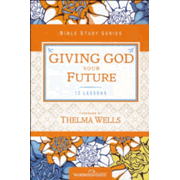
If you’re in a season where God is inviting you to loosen your grip on the future, this Bible study can be a gentle and grounding companion. Giving God Your Future walks through what it means to surrender your plans with faith, not fear, and to trust God’s direction even when the path ahead feels uncertain. It’s especially helpful if you’re seeking Scripture-based guidance for aligning your desires with God’s will this year.
|
Giving God Your Future (Women of Faith Bible Study Series)
By Women of Faith This Bible study explores what it truly means to trust God with your future and surrender your plans to His will. Through Scripture-based lessons and practical reflections, it encourages believers to say, “Not my will, but Yours be done.” Ideal for personal study or small groups, this resource helps move biblical truth from head knowledge to heart-level faith, especially in seasons of uncertainty. |